





1994 Australian F1 Grand Prix Race Report & Results
Event: Australian Grand Prix
Track: Adelaide Street Circuit
Weather: sunny, warm, dry
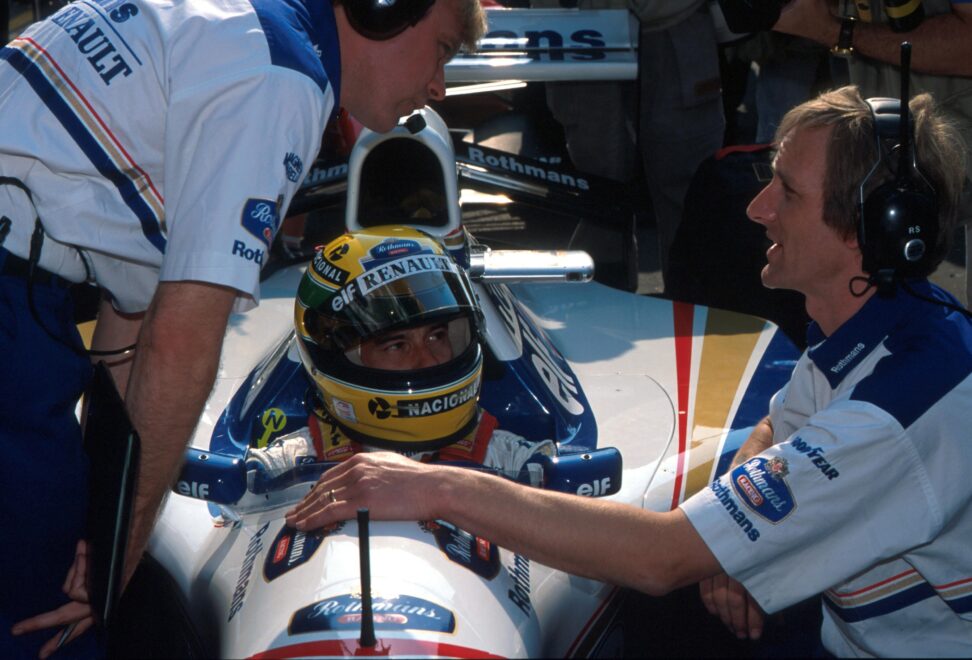
Nigel Mansell won his 31st F1 World Championship race at the 1994 Australian F1 GP today. The Williams driver started from pole and won on the Adelaide circuit for the second time. It was also his first win of the season and the 78th win for the Williams F1 team.
One point. One race. The whole season.
Adelaide arrived as the longest-anticipated showdown in F1 since Suzuka 1989. Schumacher 92, Hill 91. Hill needed to outscore Schumacher by two points to take the title; the German needed only to finish ahead. Williams led the constructors' 108-103. Both championships were in play. Bernie Ecclestone had ensured that 1995 would be Adelaide's last Australian Grand Prix, Melbourne had been awarded the race from 1996, and the South Australian organisers reciprocated with a turnout of 127,000.
The week's other paddock stories were the official confirmations. Benetton-Ford was over; Renault for 1995. McLaren-Peugeot was over; Mercedes for 1995. Shell out of McLaren after years; Mobil in. Peugeot to Jordan. Brian Hart to Arrows. Cosworth to Sauber. Mercedes had also generously waived Sauber's debts. Heinz-Harald Frentzen, having considered McLaren, stayed at Sauber. Michele Alboreto, sacked by Minardi for Luca Badoer, made his 194th and last Grand Prix start. Pacific declined to enter, and would never race again, leaving Bertrand Gachot and Paul Belmondo out of work.
Mansell's 32nd and last pole
Friday alone counted, with Saturday once again washed out. Nigel Mansell took the 32nd and final pole of his career at 1m16.179s, beating a Schumacher who would later crash heavily into the wall at the small chicane on his final qualifying lap. Hill third, Häkkinen fourth. The grid placed Schumacher between the two Williams. The Englishman knew, and Schumacher feared, that Mansell had no points to play for and could legitimately race the Benetton off the line.
Schumacher splits the Williams
Mansell fluffed his start completely. Hill made a clean launch. Schumacher, ruthlessly, slotted between them and led into the first corner. By Turn 5, Mansell had run wide onto a kerb and dropped to fifth behind Häkkinen and Barrichello. For 36 laps, Schumacher and Hill ran nose-to-tail at the front of the field. The gap between them flickered between 0.7 and 2.5 seconds, both men driving on the absolute limit, both knowing they could not afford a single mistake. By lap 12 they were 14 seconds clear of Häkkinen. By lap 20 they were lapping in the 1m17.140s range, identical lap times, sweating fingertips on the steering wheels.
The first pit stops on laps 18-19 changed nothing, Schumacher rejoined ahead of Hill. On lap 22 they were back to 0.5 seconds apart. Then on lap 32, in the Senna esses approaching Brewery Bend, Schumacher's Benetton ran briefly wide. Hill closed up. By lap 35 the gap was less than a second.
Lap 36
On lap 36, exiting the left-handed turn that fed onto Flinders Street, Schumacher ran his right wheels onto a kerb, lost the rear, and clattered the inside wall hard. He recovered the car onto the racing surface. Hill, who had been a length and a half back, saw the opening and committed to passing on the inside of the next right-hand corner. Schumacher, with his right-side suspension certainly damaged but his Benetton still steering, turned into the corner exactly as Hill arrived alongside. The two cars locked wheels. The Benetton was launched onto its right side and into the tyre wall. The Williams's left-front suspension was bent. Schumacher climbed out of the Benetton, head bowed, certain he had lost the title. Hill, his suspension folded inward, limped to the pits.
Patrick Head was at the front of the pit wall trying to bend Hill's wishbone straight by hand. It was impossible. After fifty seconds in the box, Hill removed his helmet. The world champion of 1994 was Michael Schumacher, by a single point, and by an action that, replayed in slow motion across the world's television networks that evening, would be debated for decades. Schumacher learned of the result from a marshal at the side of the track. He climbed onto a motor-bike for the return to his Benetton garage, where Briatore was already preparing the champagne.
Mansell's last hurrah
The race went on. With the championship contestants both out, Mansell inherited the lead and proceeded to win it after a furious late battle with Berger. The Ferrari had taken second after a clean strategy and a long stint, and was within a second of Mansell with twenty laps to go. On lap 64, Berger ran wide at the same turn that had decided the championship; Mansell sailed past. Brundle took third for McLaren-Peugeot, the partnership's eighth podium of the year (and the most for any first-year supplier in F1). Barrichello fourth for Jordan, Olivier Panis a brilliant fifth in the Ligier, Alesi sixth in the Ferrari after a difficult day. Mika Häkkinen, lying fourth, lost his brakes at the end of Brabham Straight on lap 77 and crashed heavily but unhurt.
It was Mansell's 31st and final career victory, taken at the age of 41, and Williams's 78th. Berger went to the post-race press conference. So did Brundle. Schumacher was already inside the Benetton motorhome being toasted. Hill, when finally he emerged from the Williams garage, refused to be drawn into controversy: "I gave everything I could. A terrible race. All I can say now is that it didn't end the best way for me. People got their money's worth and we gave them something to talk about for years!"
What 1994 was
Michael Schumacher's first World Championship, at 25 years 10 months, made him the second-youngest world champion in history. Williams secured its third consecutive constructors' title despite losing the drivers'. The two competitors had ended the season exactly one point apart, which had not happened in 30 years and was a measure of how thoroughly the FIA's mid-season interventions had reshaped what had originally looked like a Schumacher procession. Schumacher, on the podium, surprised observers with grace: "This year I made some unrespectful comments about Damon. I must admit my wrongs. What he did, particularly in the last two races and even before, was fantastic. He was a great rival and I apologise for what I said." Then, his voice catching: "At the start of this season it was clear to me that the title would go to Ayrton Senna. He was no longer there in the last months, so I dedicate this championship to him. He had the best car and was the best driver. I always thought of him this year, even if I don't often show my feelings."
Hill, in private, watched a tape of the lap-36 collision and concluded that Schumacher had turned in deliberately. Several Williams insiders demanded the FIA review the incident. Hill, on Barry Sheene's counsel, said nothing publicly. Alain Prost, asked for his view, recognised what had happened: "Michael showed he was a true racing driver. He shut the door instinctively. It was the only thing he could do at that moment. An act of self-defence, not attack." Prost's defence inevitably echoed his own Suzuka 1989 with Senna. Jack Brabham, asked the same question, thought Hill had been too impatient, Schumacher's damaged car would not have made it through the next acceleration zone. Both could be true.
1994 had begun as a Williams procession and become, after Senna's death at Imola, a season of grief, scandal and politics: two driver deaths in a weekend, the GPDA's rebirth, sweeping mid-season rule changes, four separate Benetton investigations (the launch control, the black flag at Silverstone, the Verstappen fire, the Spa skid block), Schumacher's two-race ban, Mansell's brief comeback, Coulthard's emergence, Hill's transformation from journeyman to championship contender, and finally a title decided by a collision with no marshals' verdict. Tony Bouhid, the StatsF1 reporter whose summary ended every race report that year, concluded: "The worst season in the entire history of Formula 1." Most observers, looking back, would agree. But it was over. The 1995 season, with Schumacher in his Renault-engined Benetton, Hill in his Williams, Coulthard, Häkkinen in the McLaren-Mercedes, Alesi seeking that elusive first win, Mansell again retired, was already three months away.
Classification 1994 Australian F1 GP





Fastest lap: 1:17.140 min by Michael Schumacher (Benetton B194) in lap 29
✅ Check out 1994 F1 Championship Standings
✅ Check out 1994 F1 Teams & Drivers
✅ Check out All Time F1 Drivers Rankings
✅ Check out All Time F1 Driver Records
✅ Check out All Time F1 Teams Rankings








Last F1 Fan Comment

An Sionnach on Benoit warns F1 season could end in Vegas this weekend3 hours ago
All F1 Fan Comments