





Why Formula 1 Will Miss Zandvoort After 2026

When the chequered flag falls on 23 August, Formula 1 will not simply complete another Grand Prix. It will close one of the most colourful, atmospheric and unlikely chapters in the sport’s modern history.
The 2026 Dutch Grand Prix is Zandvoort’s last contracted Formula 1 race. There will be a Sprint, packed grandstands and one final orange invasion of the Dutch coast. After that, the calendar moves on.
Formula 1 will survive, of course. It always does. Yet Zandvoort’s departure will remove something increasingly difficult to find: a race with its own landscape, rhythm, history and unmistakable personality.
Zandvoort Is Leaving at Full Volume

The start during the F1 Grand Prix of Netherlands at Circuit Zandvoort on August 31, 2025 (Photo by Clive Rose/Getty Images) // Getty Images / Red Bull Content Pool // SI202508310198 // Usage for editorial use only //
The Dutch Grand Prix is not disappearing because people stopped attending. Saturday and Sunday tickets for the final weekend sold out months in advance, while the event remains one of the most recognisable on the calendar.
Nor was Formula 1 desperate to leave. Annual and alternating contracts were among the options discussed before the promoter decided to stop after 2026.
That distinction matters.
Zandvoort is a privately owned and operated event. Its organisers carry the commercial risks that come with hosting modern Formula 1, from rising costs and infrastructure demands to the difficulty of guaranteeing ticket sales several years ahead.
The return was originally built around Max Verstappen’s extraordinary popularity. That made the event possible, but also left its long-term commercial strength closely connected to one driver and one remarkable period in Dutch motorsport.
Rather than gamble with that success, the organisers chose to finish while demand remained high. As the official announcement explained, the decision followed extensive discussions with Formula One Management and reflected the risks and responsibilities facing a private promoter.
There is something refreshingly sensible about going out with full grandstands instead of waiting for the party to empty. It does not make the loss any smaller.
A Circuit That Still Demands Commitment

Kevin Magnussen, Haas VF-24, goes off the track and into the gravel during the Dutch GP at Circuit Zandvoort on Sunday August 25, 2024 (Photo by Andy Hone / LAT Images)
Modern Formula 1 circuits are often designed around generous run-off areas, carefully calculated overtaking zones and enough space to accommodate a small airport.
Circuit Zandvoort follows a different philosophy.
The 4.259-kilometre track twists through the dunes with 14 corners, constant changes of direction and barely a moment for the drivers to relax. It is narrow, fast and unforgiving. Gravel waits beyond the asphalt, while the North Sea wind can alter the balance of a car between one lap and the next.
Turn 3 throws the cars into steep banking before they climb through the middle sector. Scheivlak demands commitment at high speed. The 18-degree Arie Luyendykbocht then launches drivers onto the main straight in a manner unlike anything else on the calendar.
The circuit is not perfect. Overtaking can be difficult and races sometimes become heavily dependent on qualifying position and strategy. Zandvoort has never pretended otherwise.
Yet judging a circuit entirely by its number of overtakes misses the point. Every qualifying lap here carries tension because a small mistake has consequences. Drivers attack corners instead of merely navigating between braking zones. The track looks fast from the grandstands and even faster from the cockpit.
That matters. Formula 1 needs circuits that test courage and precision, not only venues capable of producing a large overtaking statistic.
History Is Built Into the Dunes
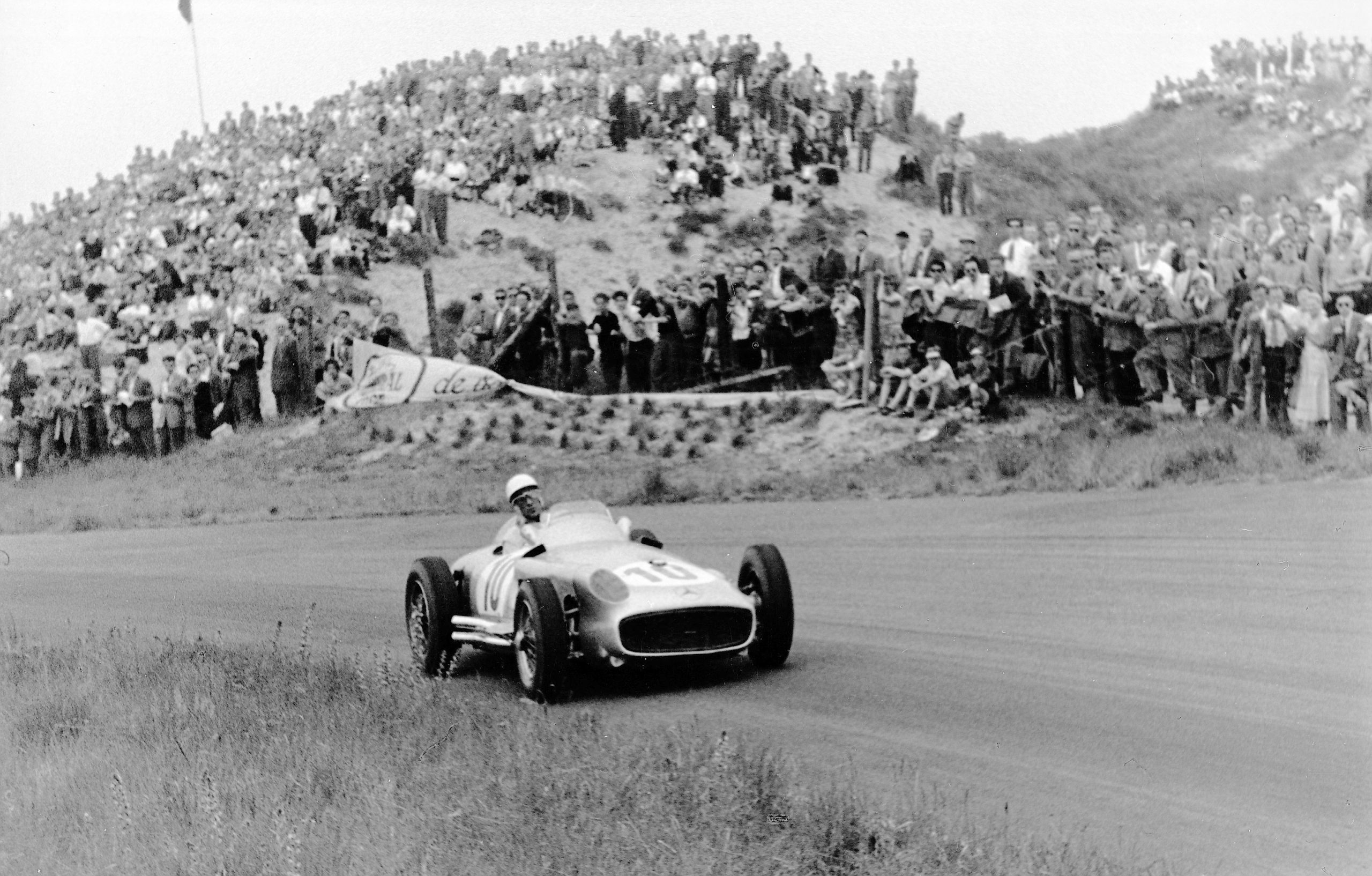
Dutch Grand Prix in Zandvoort on 19 June 1955. Stirling Moss, who later finished second, in a Mercedes-Benz Formula One racing car W 196 R (start number 10).
Zandvoort opened in 1948 and joined the Formula 1 World Championship in 1952. Alberto Ascari won that inaugural championship race as Ferrari swept the podium.
The circuit soon became part of Formula 1’s European identity. Jim Clark remains its most successful driver with four victories, including a hugely significant win in 1967 with the new Lotus 49 and Ford Cosworth DFV engine.
That engine went on to transform Formula 1. Its story began with victory in the Dutch dunes.
Zandvoort also hosted James Hunt’s maiden Grand Prix win in 1975. Hunt and the small Hesketh team defeated Niki Lauda’s Ferrari after a perfectly timed switch from wet tyres to slicks, producing one of Formula 1’s great underdog victories.
Ten years later, Lauda won the final Dutch Grand Prix of Zandvoort’s original era. Starting tenth, he fought through the field and resisted McLaren team-mate Alain Prost to win by just 0.232 seconds. It proved to be the 25th and final victory of Lauda’s career.
Not every chapter was celebratory. The deaths of Piers Courage in 1970 and Roger Williamson in 1973 remain painful parts of the circuit’s history and reminders of a far more dangerous era.
When Formula 1 departed after 1985, few expected it to stay away for 36 years. The planned 2020 return was delayed by the pandemic, but when the championship finally came back in 2021, Zandvoort felt both familiar and completely reborn.
The circuit had been modernised, its banking intensified and its facilities transformed. Crucially, its character had survived.
Verstappen Turned a Race Into a National Event
Zandvoort’s revival cannot be separated from Max Verstappen.
The Netherlands had produced Formula 1 drivers before, but never a champion capable of mobilising an entire country. Verstappen’s rise transformed Dutch interest in the sport and created the audience required to bring Formula 1 home.
Bernie Ecclestone recently argued that Verstappen alone made the Dutch Grand Prix return possible. That may simplify the enormous organisational effort behind the event, but the central point is difficult to dispute. Without Verstappen, there would almost certainly have been no modern Zandvoort era.
His victory in 2021 provided the perfect opening. Verstappen arrived locked in a title fight with Lewis Hamilton, took pole under immense pressure and controlled the race in front of a crowd that treated every lap like a winning goal.
He won again in 2022 before surviving rain, changing conditions, Safety Cars and a red flag to complete his home hat-trick in 2023. That third victory equalled Sebastian Vettel’s then-record of nine consecutive Formula 1 wins.
The script changed afterwards. Lando Norris dominated in 2024, proving that even the Orange Army could not drag Verstappen beyond the limits of his car. Oscar Piastri then won a chaotic 2025 race in which Norris retired, both Ferraris crashed out and Isack Hadjar claimed a breakthrough podium.
Those results helped Zandvoort grow beyond a single-driver celebration. Verstappen remained its centre of gravity, but the circuit continued producing stories that belonged to the wider championship.
The Orange Army Changed Formula 1’s Atmosphere

Fans show their support ahead of the F1 Grand Prix of The Netherlands at Circuit Zandvoort on September 05, 2021 (Photo by Boris Streubel/Getty Images) // SI202109051556 // Usage for editorial use only //
There are enthusiastic crowds across Formula 1. Few have changed the visual identity of a Grand Prix as completely as the Dutch fans.
Entire grandstands disappear beneath orange shirts, flags and, occasionally, rather more smoke than the television cameras would prefer. The atmosphere begins before the gates open and spreads through the town, railway stations, campsites and beach bars.
Plenty of races market themselves as festivals. Zandvoort genuinely feels like one because the event is not contained within the circuit. For one weekend, the entire coastal town becomes part of Formula 1.
That sense of collective participation is difficult to manufacture. It emerged naturally from Verstappen’s success, Dutch sporting culture and the compact location.
The circuit’s size helps. Spectators are close to the track, the grandstands appear to sit on top of the action and the roar follows the cars around the lap. Zandvoort feels alive even during practice.
Formula 1 will find other large crowds. Replacing this particular atmosphere will be considerably harder.
Zandvoort Also Showed Events Could Operate Differently
The Dutch Grand Prix did more than organise a loud weekend beside the sea. It became a useful example of how a major Formula 1 event could move enormous numbers of people without surrounding the circuit with endless traffic.
In 2023, 98 per cent of visitors travelled to and from the event using sustainable transport. Tens of thousands arrived by bicycle, while others used additional trains or walked from the town.
The organisers also connected more of the venue to a permanent green power grid. Fuel consumption fell from 120,000 litres in 2021 to 40,000 in 2023, while the switch to HVO100 helped reduce the event’s reported climate footprint by 94.5 per cent compared with its first year. Formula 1 highlighted these measures as examples for other promoters.
Not every race can copy Zandvoort. Few circuits have a railway station within walking distance or a cycling culture capable of delivering 40,000 fans to the gates.
The broader lesson remains valuable: a Grand Prix does not automatically require every spectator to arrive by car. Zandvoort found solutions shaped by its location instead of treating that location as a problem.
Formula 1 Will Lose More Than a Dutch Race

Max Verstappen of the Netherlands driving the (1) Oracle Red Bull Racing RB21 leads Lando Norris of Great Britain driving the (4) McLaren MCL39 Mercedes on track during the F1 Grand Prix of Netherlands at Circuit Zandvoort on August 31, 2025 (Photo by Sam Bagnall/Sutton Images) // Getty Images / Red Bull Content Pool // SI202508310210 // Usage for editorial use only //
The modern calendar is under relentless pressure. New countries want races, established venues need viable contracts and Formula 1 must balance commercial growth against its history.
Zandvoort’s departure is therefore understandable. A successful event can still become financially risky, particularly when its promoter does not have unlimited public funding behind it.
What Formula 1 loses, however, is a permanent European circuit that looks and feels unlike anything else.
Zandvoort is not interchangeable with another venue. Its banking, dunes, weather, narrow layout and orange grandstands form one complete identity. Remove any of those elements and the event becomes something different.
That is why its absence will be felt. Formula 1 can build larger paddocks, longer straights and more elaborate hospitality suites elsewhere. It cannot recreate the North Sea wind, a railway carriage packed with orange-clad supporters or the sight of an F1 car cresting the dunes at full commitment.
The calendar may gain another impressive facility. It will still lose a little character.
One Final Sprint Through the Dunes
Zandvoort will at least receive a proper farewell.
The final weekend runs from 21 to 23 August and includes the first Dutch Grand Prix Sprint. With only one practice session before Sprint Qualifying, teams will have little time to understand the 2026 cars on one of the calendar’s least forgiving circuits.
Every day will carry competitive meaning. Every Verstappen lap will generate noise. Every grandstand will know that it is watching something for the final time.
Whether Zandvoort ever returns is impossible to know. Formula 1 rarely closes a door permanently, and future promoters, commercial conditions or Dutch drivers could change the equation again. For now, there is no Dutch Grand Prix beyond 2026.
Max Verstappen has already warned that his fame alone cannot sustain Dutch motorsport forever. That gives the farewell significance beyond one race. It marks the end of the era in which a Dutch driver, a revived circuit and an extraordinary fan movement converged at precisely the right moment.
Zandvoort’s comeback will have lasted only six editions. That was enough to remind Formula 1 what a Grand Prix with genuine identity looks like.
The 2027 calendar will still be full, but it will feel a little emptier.

2 F1 Fan comments on “Why Formula 1 Will Miss Zandvoort After 2026”
💬 Join the conversation — see the latest comments from F1 fans →


I won’t really miss Zandvoort.
Im going to gamble that the fans at Zandvoort have a better weekend than the Sand tracks in the middle east,a race weekends about a good all round atmosphere to (for the fans that go) Imo