





Ground Effect
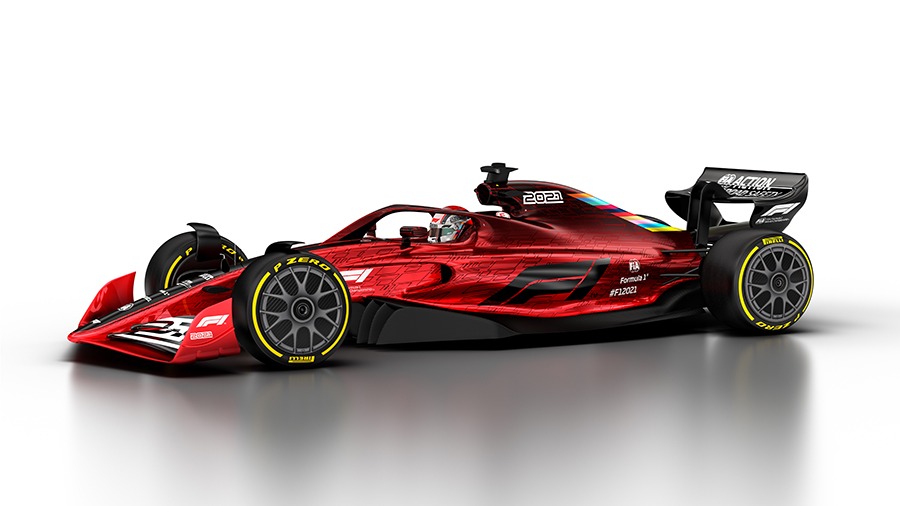
2021 concept ground effect F1 car
Ground effect is the aerodynamic principle that lets a Formula 1 car generate downforce by shaping the space beneath its floor. A car with a properly designed underbody effectively becomes an inverted aerofoil, drawing itself to the road through the low-pressure zone it creates beneath the chassis. Ground effect defined the Lotus era of the late 1970s, was banned after 1982, and returned in force with the 2022 regulations.
What is ground effect in Formula 1?
Ground effect is the aerodynamic downforce produced by accelerating air beneath the car. Bernoulli's principle tells us that as air speeds up, its pressure drops. If a car's underbody is shaped to accelerate the airflow beneath it, the pressure under the car drops below ambient pressure, and the difference between ambient pressure above the car and low pressure below sucks the whole chassis onto the road. That vertical force is downforce, without a significant drag penalty.
Lotus and the original ground-effect era, 1977 to 1982
Colin Chapman's Lotus 78 introduced the concept in 1977, sculpting the underside of the sidepods into inverted aerofoils. Its successor, the Lotus 79, dominated 1978. Skirts, spring-loaded panels along the edges of the sidepods, sealed the low-pressure zone against the road. Rival teams followed with increasingly aggressive designs, cornering speeds and driver g-loads climbed to levels that alarmed the FIA, and the technology was banned by mandating flat bottoms for 1983.
The 2022 return of ground effect
Ground effect returned as the centrepiece of the 2022 aerodynamic regulations, reshaped for the modern era with mandatory Venturi tunnel geometry, and without skirts. Around 60 per cent of a modern F1 car's downforce comes from the floor and its diffuser. The stated goal was to reduce dirty-air losses and let cars follow each other more closely, and the change did improve overtaking without eliminating the dominance of clean air.
Porpoising and the ground-effect trade-off
Ground-effect cars are extremely sensitive to ride height. If the floor gets too close to the ground the airflow stalls, downforce collapses, the car rebounds up, downforce returns, and the cycle repeats. That oscillation is called porpoising and defined the 2022 season, forcing teams to raise ride heights and stiffen floors. The FIA introduced technical directives to police the effect and have progressively tightened floor stiffness rules ever since.
Frequently asked questions about ground effect
What is ground effect in F1?
Ground effect is the downforce generated by accelerating airflow beneath the car to create a low-pressure zone that sucks the chassis to the road.
Which team pioneered ground effect?
Lotus pioneered modern ground effect with the Lotus 78 in 1977 and Lotus 79 in 1978. Both cars used sculpted sidepods and skirts to seal the low-pressure zone beneath the floor.
Why was ground effect banned in 1983?
Because cornering speeds and driver loads had reached levels the FIA regarded as unsafe. Flat bottoms were mandated from 1983, and skirts were banned.
How does modern F1 use ground effect?
The 2022 regulations reintroduced ground effect with mandated Venturi tunnel geometry beneath the floor. Around 60 per cent of a modern F1 car's downforce now comes from the floor.
What is porpoising?
Porpoising is a vertical oscillation caused when a ground-effect car's floor gets too close to the road, stalls its downforce, and rebounds upward, before the cycle repeats. It was the defining technical issue of the 2022 season.








LAST 3 F1 Fan COMMENTS

Shroppyfly on Honda stops short of backing F1's V8 return6 hours ago 
Nobodysperfect on Honda stops short of backing F1's V8 return7 hours ago 
Shroppyfly on Red Bull stays quiet on Verstappen's new 80 million deal7 hours ago
All F1 Fan Comments