





Red flag
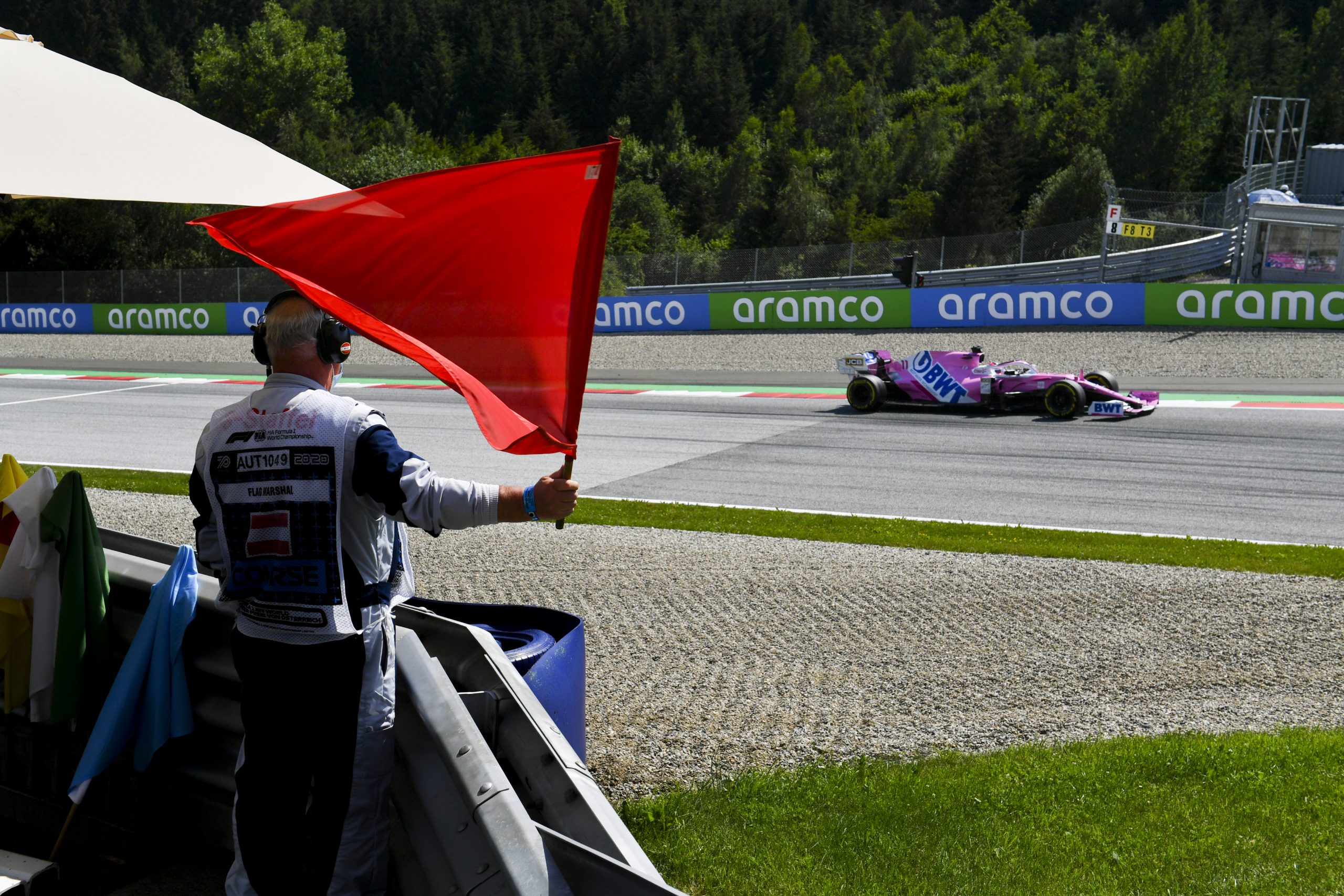
Marshal waves red flag as Sergio Perez, Racing Point RP20 passes by
The red flag is Formula 1's stop signal, shown when track conditions are unsafe enough that the session cannot continue. The moment it appears, drivers must slow to a controlled pit-lane speed and return to the pit lane, and Race Control takes over. Red flags decide championships more often than fans imagine: the neutralisation resets pit stops, tyre choices and gaps in a single call.
What is a red flag in F1?
A red flag is the FIA signal that stops a session immediately. It is used when there is a major incident on the track, when a barrier needs repair, when debris cannot be cleared under a Safety Car, or when weather conditions become too extreme for safe racing. When shown, drivers must slow immediately, follow the marshal instructions, and return to the pit lane at controlled speed.
What happens under a red flag
- the session clock stops;
- all cars return to the pit lane at controlled speed;
- the field lines up in the pit lane in race order at the moment of the red flag;
- teams are permitted certain repairs, including tyre changes, that would normally be a pit stop;
- the FIA sets a restart procedure once conditions allow.
Red-flag restart procedure
Once the track is judged safe again, cars leave the pit lane behind the Safety Car, form up on the grid or in the pit lane exit order, and complete a Safety Car run before either a rolling start or a standing restart is declared. The choice depends on how much of the race remains and how confident Race Control is in the surface. Recent race directors have preferred standing restarts wherever possible to preserve the sporting drama.
The 75 per cent rule
If a race is red-flagged and the leader has completed less than two full laps, no points are awarded. If they have completed at least two laps but less than 75 per cent of the scheduled distance, half points are awarded on a sliding scale. Above 75 per cent, full points apply. The scale was introduced after the controversial 2021 Belgian Grand Prix, which awarded half points for effectively no racing at all.
Frequently asked questions about the red flag
What is a red flag in F1?
A red flag stops the session immediately. Drivers must slow and return to the pit lane at controlled speed while Race Control manages the incident.
Can teams work on the car during a red flag?
Yes. Certain repairs, including tyre changes, are permitted during a red-flag suspension. This makes them strategically significant.
How does a red-flag restart work?
Once conditions are safe, cars leave the pit lane behind the Safety Car and form up for a rolling or standing restart chosen by Race Direction.
What is the 75 per cent rule?
If a race is red-flagged before 75 per cent of the scheduled distance is complete, points are awarded on a sliding scale. Above 75 per cent, full points apply.
What is the difference between a red flag and a Safety Car?
A Safety Car neutralises the race but keeps the field moving on track. A red flag stops the session entirely and sends everyone back to the pit lane.






LAST 3 F1 Fan COMMENTS

Shroppyfly on Hadjar targets Monza return as Red Bull delays wrist decision13 hours ago 
Jere Jyrälä on Hadjar targets Monza return as Red Bull delays wrist decision18 hours ago 
Shroppyfly on Vowles Admits Williams Is Still Paying for Winter Mistakes1 day ago
All F1 Fan Comments