




Pits

Drivers driving in the pits during the 2025 F1 Brazilian grand prix.
The pits are the row of garages along the main straight of a Formula 1 circuit, where teams work on the cars between sessions and during pit stops. Each team occupies two adjacent boxes, one per car, in a strict qualifying-order layout that the FIA sets before the season begins. Everything a car needs during a race weekend that cannot fit in the paddock lives in the pits.
What are the pits in Formula 1?
The pits are the garages along the pit lane, one row per team, from which mechanics and engineers prepare and repair the car during a Grand Prix weekend. Each team has two garages, one for each car. Their equipment, spares and race trolleys are kept there for the duration of the event, and Race Control watches every garage on live camera through the session.
Layout and allocation
- Order: based on the previous year's constructors' championship, with the champion team usually taking the box closest to Race Control;
- Boxes per team: two, side by side;
- Equipment: tyre trolleys, air jacks, wheel guns, front and rear wing spares, telemetry rigs and race-strategy dashboards;
- Crew: mechanics, chief mechanic, race engineers, tyre technicians and the pit-stop crew, plus visiting engineers on rotation;
- Overhead space: often used for engineers' briefing rooms.
What happens in the pits during a race
Pit stops are the most visible activity: cars come in for tyre changes, and elite crews complete a four-wheel change in around 2.0 seconds. Between stops the pit crew watches the race, monitors tyre pressures on their laptops and prepares for the next window. In case of damage the pit garage is where nose changes, front-wing swaps and other quick repairs happen. Anything that cannot be fixed within a few pit-lane transits usually means retirement.
The pit exit and safety car line
The pit exit is the narrow lane where cars rejoin the racing surface after a pit stop. Its position is marked with a solid painted line that drivers must not cross while in the pit lane. Beyond it, the driver is fully racing again. Race Control also uses a Safety Car line here to determine whether a car has committed to a pit stop or is still on the track when the SC is deployed.
Latest pit-stop news

Red Bull's "What it Takes": The Perfect F1 Pit Stop
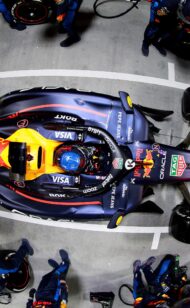
Red Bull's Fasterclass: Breaking Down an F1 Pit Stop

Game-Changer? F1's Innovative Livery Rule Explained
2
Controversial Two-Stop Idea: F1 Drivers Respond

Wheatley's Leadership Elevates Sauber to F1 Pitstop Elite

Bottas Furious: Sauber's Slow Pitstops Slam Team's Prospects
1
F1 Showdown: Pirelli Aims for Two-Stop Thrillers & Red Bull
1
Revving Up Zandvoort: F1 Teams Gain Extra Space in New
Hamilton admits: Mercedes' straight-line speed lags behind Red Bull
Frequently asked questions about the F1 pits
What are the pits in F1?
The pits are the garages along the pit lane where teams keep their cars, spares and equipment during a race weekend, and where they work on the car between sessions.
How are pit-garage positions decided?
The FIA allocates pit garages based on the previous year's constructors' championship, with the champion team typically taking the garage nearest to Race Control.
How many people work in a pit garage?
During a session, around 20 to 30 team members work directly in the garage, from mechanics to engineers and tyre technicians. More work above in engineering rooms.
What is the pit exit?
The pit exit is the point at which cars rejoin the racing surface after a pit stop. Drivers must stay inside the painted lines until they cross the exit and are considered racing again.
How fast is a modern pit stop?
Elite crews complete a four-wheel change in around 2.0 to 2.3 seconds. The world record is 1.80 seconds, set by McLaren.
Last updated: