





Grand Prix
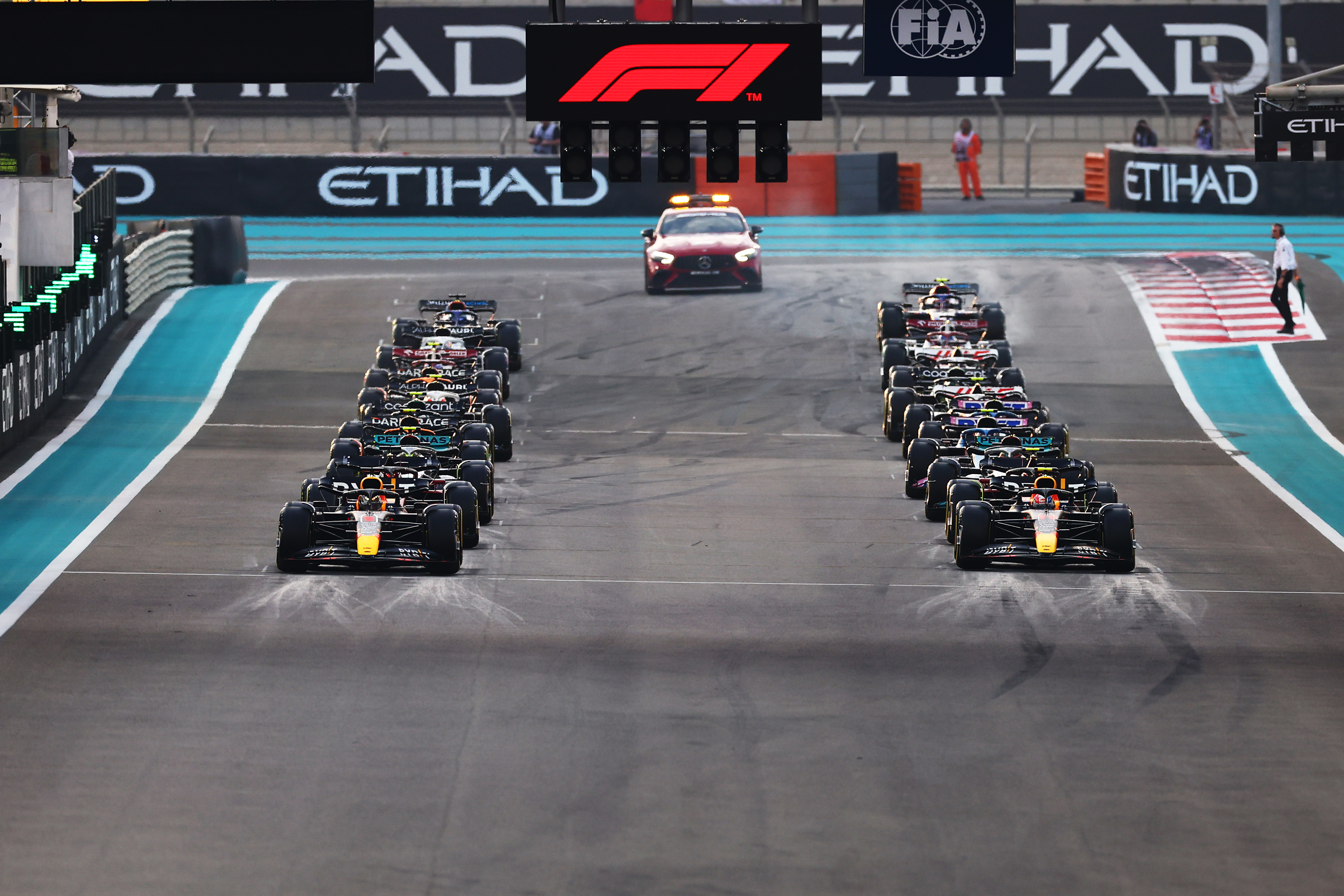
Start of the 2022 Abu Dhabi F1 Grand Prix
A Grand Prix is a Formula 1 race that counts toward the FIA World Championship, and the word itself carries a hundred years of motor-racing history. Each round of the F1 calendar is officially a Grand Prix, named for the host country or region, and hosting one is a national prestige event as much as a sporting one.
What is a Grand Prix in Formula 1?
A Grand Prix, French for "great prize", is an FIA World Championship race that awards points toward both the drivers' and constructors' titles. It runs on a designated Sunday, is preceded by two or three practice sessions and a qualifying session, and typically covers a race distance of between 305 and 310 km depending on the circuit. The Monaco Grand Prix, at 260 km, is the historic exception.
Where the word comes from
The first race to be called a Grand Prix was the 1906 Grand Prix de l'Automobile Club de France at Le Mans, a two-day event won by Ferenc Szisz in a Renault. Other national clubs quickly adopted the same naming convention, and by the 1920s the term Grand Prix was synonymous with the top tier of international motor racing. Formula 1 inherited the term when the FIA World Championship began in 1950.
How a Grand Prix weekend runs
- Friday: Free Practice 1 and 2, or, at Sprint events, FP1 and Sprint Qualifying;
- Saturday: Free Practice 3 and qualifying, or, at Sprint events, the Sprint race and Grand Prix qualifying;
- Sunday: the Grand Prix itself, run at a set start time to synchronise with global broadcast windows.
What counts as a Grand Prix
Only rounds of the FIA Formula 1 World Championship are official Grands Prix, though non-championship races that used the same title were held regularly through the 1950s, 1960s and early 1980s. The modern calendar contains 24 Grands Prix in a peak season, from Australia in March to Abu Dhabi in December, with occasional double-headers and back-to-back weekends to fit them all in.
Frequently asked questions about the Grand Prix
What does Grand Prix mean?
Grand Prix is French for "great prize". It refers to a top-tier motor race, and in modern F1 to a round of the FIA World Championship.
When was the first Grand Prix?
The first race to be titled a Grand Prix was the 1906 Grand Prix de l'Automobile Club de France at Le Mans, won by Ferenc Szisz in a Renault.
How long is a Formula 1 Grand Prix?
Race distance is set at approximately 305 km (260 km at Monaco) or, if reached first, a two-hour time limit. Under Safety Car conditions the total time limit is extended to three hours.
How many Grands Prix are on the F1 calendar?
The modern calendar has featured up to 24 Grands Prix in a peak season, from March in Australia to December in Abu Dhabi.
Are all F1 races Grands Prix?
Every round of the FIA F1 World Championship is a Grand Prix. Sprint races, held on Saturdays at some events, are not Grands Prix and do not use the title in their name.


LAST 3 F1 Fan COMMENTS

Shroppyfly on Lawson close to new Racing Bulls deal before Las Vegas27 minutes ago 
Shroppyfly on Ralf Schumacher: Hamilton still not quick enough at Ferrari29 minutes ago 
Shroppyfly on Piastri ends management deal with Webber after tough year32 minutes ago
All F1 Fan Comments