





Turbulence
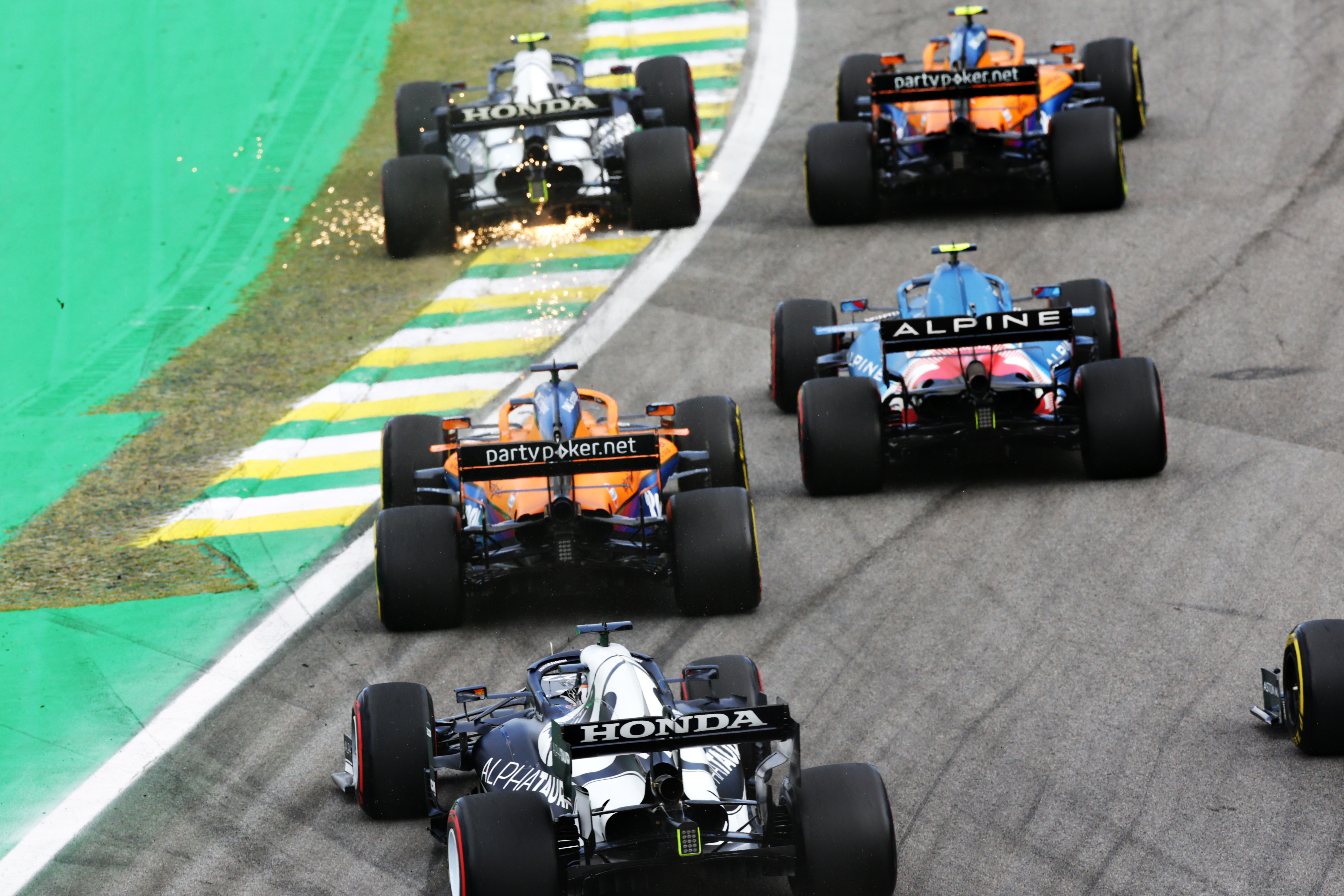
Several cars following eachother during the sprint ahead of the 2021 F1 Grand Prix of Brazil
Turbulence is the disturbed, irregular airflow left in the wake of a Formula 1 car, and it is the single reason two cars struggle to run close together. Every aero surface on a car produces vortices and wake structures, and any car sitting behind them meets air that is neither steady nor at the right angle. Turbulence is what dirty air is made of, and reducing it was the central goal of the 2022 regulations.
What is turbulence in F1?
Turbulence is chaotic, low-pressure airflow shed by a moving F1 car. Every wing element, tyre, sidepod and floor generates some. The result is a swirling, unpredictable wake that stretches for several car lengths behind the vehicle. The car following into that wake meets air that has none of the smooth, steady properties its own aerodynamic surfaces were designed for.
Where turbulence comes from
- Front and rear wings: vortices shed by the endplates;
- Open wheels: tumbling, unsteady flow behind each rotating tyre;
- Diffuser exits: large-scale wake structures behind the floor;
- Engine cover and airbox: vortex shedding from every upper-body panel;
- Brake ducts: tightly rotating vortices from the front wheels.
Turbulence and dirty air
"Dirty air" is the paddock word for the turbulent wake of a car ahead. When a following car enters that wake it loses front wing downforce, floor pressure and cooling flow. Under the pre-2022 rules dirty air could cost roughly 35 per cent of the following car's downforce at one car length. Under the current rules that figure has dropped to about 20 per cent, which is why close following is possible even without DRS.
The 2022 turbulence rewrite
The FIA and Formula 1 rewrote the aerodynamic regulations for 2022 specifically to reduce the turbulence a car leaves behind. Bargeboards were removed to eliminate outwash. Rear wings were redesigned to roll their tip vortices upward instead of outward. Downforce moved to the floor, whose wake is much smaller than a wing-heavy car's. The result is measurably cleaner air behind the car and much closer racing.
Frequently asked questions about turbulence
What is turbulence in F1?
Turbulence is the disturbed, irregular airflow shed by a Formula 1 car as it moves through the air. It reduces the downforce of any car following closely.
What is the difference between turbulence and dirty air?
Dirty air is the paddock name for turbulence in the specific context of a following car. Both refer to the same phenomenon.
How did the 2022 rules reduce turbulence?
By removing bargeboards, reshaping rear wings to roll vortices upward, and moving downforce to the underfloor. Together these changes cut downforce loss from about 35 per cent to about 20 per cent at one car length.
Which parts of the car produce the most turbulence?
Historically the rear wing, bargeboards and open wheels. Under the current rules the rear wing endplate design and diffuser exit still contribute significantly.
Does DRS eliminate turbulence?
No. DRS reduces drag on the following car by opening the rear wing flap. It does not change the turbulent wake shed by the leader.








LAST 3 F1 Fan COMMENTS

Shroppyfly on Honda stops short of backing F1's V8 return7 hours ago 
Nobodysperfect on Honda stops short of backing F1's V8 return8 hours ago 
Shroppyfly on Red Bull stays quiet on Verstappen's new 80 million deal9 hours ago
All F1 Fan Comments