





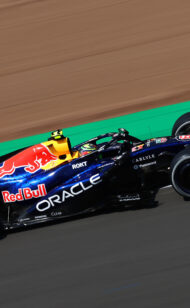
Wing endplate

Esteban Ocon (FRA) Alpine F1 Team A523. Formula One Testing, Day Two, Friday 24th February 2023. Sakhir, Bahrain.
The wing endplate is the vertical panel at each outer edge of a Formula 1 front or rear wing, and it does far more than close off the ends of the aerofoil. It controls tip vortices, shapes the outwash pattern from the front wing, and defines how the wing behaves in yaw. A well-designed endplate can turn a marginal wing into a title-winning one.
What is a wing endplate in F1?
A wing endplate is a vertical or near-vertical panel fitted to the outer edges of a front or rear wing. Structurally it holds the wing elements together. Aerodynamically it manages the vortices that form where the high-pressure lower surface meets the low-pressure upper surface at the wing tips. Without the endplate the wing would leak flow around its tips and lose downforce.
What endplates do
- seal the pressure differential across the wing tips;
- shape tip vortices, either strengthening them for downstream benefits or minimising them to reduce drag;
- direct outwash flow around the front wheels on front-wing endplates;
- generate secondary downforce through local pressure differences;
- define the wing's behaviour in yaw when the car is turning.
Front-wing endplates and outwash
Pre-2022, front-wing endplates were designed to throw airflow outward around the front tyres and away from the floor. That outwash was one of the biggest generators of dirty air, and the 2022 regulations rewrote the front-wing endplate rules to make an outwash-heavy design nearly impossible. Modern endplates are simpler, curve inward, and are designed to feed cleaner flow toward the sidepod inlets and floor.
Rear-wing endplates and 2022 changes
Rear-wing endplates were also drastically reshaped for 2022. The FIA required them to roll their tip vortices upward instead of outward, which is why modern rear wings meet the endplate in a continuous, rounded curve rather than a sharp corner. The change was designed specifically to reduce dirty air behind the car and improve following.
Latest wing news

Ferrari's Query Spurs Changes in Mercedes Front Wing
3
Revolutionary F1 Design: Ferrari's 'Macarena' Wing Hits Shanghai

Alpine's Bold Strategy: Embracing New F1 Aero Challenges
2
Mercedes' Secret Edge? New Controversy Over 'Flexi Wings'

Tombazis Speaks Out On Further Flexi-Wing Tests by the FIA

Barcelona Front Wing Clampdown: FIA Not Ruling Out Tougher Tests

Barcelona Clampdown: Will it Affect McLaren and the Pecking Order?
1
How Many F1 Teams Made Flexi-Wing Changes? FIA Responds
5
F1 Flexi-wing Saga Strikes: First 'Victim' in China
4
Frequently asked questions about wing endplates
What is a wing endplate in F1?
A wing endplate is a vertical panel at the outer edge of an F1 front or rear wing that seals the tip pressure differential and shapes tip vortices.
Why do wing endplates matter?
They prevent the wing from leaking flow around its tips, shape the vortices for downstream aerodynamic benefit, and directly influence dirty-air performance.
How did the 2022 rules change endplates?
Front-wing endplates lost their outwash-heavy shape. Rear-wing endplates now roll tip vortices upward instead of outward. Both changes were designed to reduce dirty air.
Do all wings need endplates?
Yes. Without endplates, high-pressure flow under the wing would leak around the tips and equalise pressure with the upper surface, destroying the downforce production.
Are wing endplates a listed team component?
Yes, along with the wings themselves. Each team must design their own endplates and cannot license or share designs with other constructors.
Last updated:


