





Diffuser
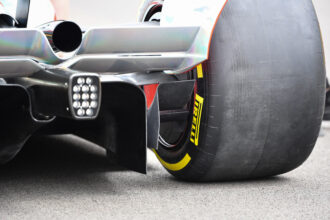
The diffuser sits at the rear of the floor, expanding airflow back to ambient pressure and multiplying floor efficiency.
The diffuser is the ramp at the back of a Formula 1 car's floor, and it is one of the most important aerodynamic surfaces on the whole machine. It expands the airflow that has been accelerated beneath the floor back to ambient pressure, and in doing so multiplies the amount of downforce the underbody can produce. On modern ground-effect cars the diffuser is not a supporting act, it is the payoff.
What is a diffuser in Formula 1?
A diffuser is an upward-curving section at the rear of the underfloor. When air flowing beneath the car enters the diffuser, the increasing cross-sectional area causes the flow to decelerate and its pressure to rise back to ambient. Because the pressure downstream of the floor sets the pressure everywhere upstream, a well-designed diffuser lets the whole floor operate at lower pressure, and lower pressure means more downforce.
How a diffuser works
The physics is a straightforward application of Bernoulli's principle. Air accelerates through the narrow Venturi channels beneath the floor, dropping its pressure. Without a diffuser, that low-pressure air would meet ambient pressure at the trailing edge in a mess of separated flow. The diffuser gives it a controlled expansion path back to ambient, keeping the flow attached and preserving the low-pressure zone under the floor. It is the difference between a Venturi tunnel that works and one that stalls.
Diffusers through the eras
The ground-effect years, 1977 to 1982
Diffusers first became a decisive component during the original ground-effect era pioneered by the Lotus 78 and 79. Sidepod tunnels ended in aggressive diffusers that sucked the whole chassis onto the road.
The double diffuser controversy of 2009
In 2009 Brawn GP, Toyota and Williams exploited a regulatory loophole to run a "double-decker" diffuser, adding a second airflow path above the primary channel. The FIA ruled the concept legal after protest, and it defined that season and helped Jenson Button and Brawn GP win a championship no one had predicted.
Blown diffusers, 2010 to 2013
Between 2010 and mid-2013 several teams routed exhaust gases into the diffuser to energise the flow and generate extra downforce. The FIA progressively banned the practice as it began to distort engine calibration and increase costs.
The 2022 ground-effect return
The current regulations reintroduced ground-effect floors, and the diffuser is once again the payoff surface for the underfloor Venturi tunnels. Around 60 per cent of the downforce on a modern F1 car depends on how well the diffuser expands the underfloor flow.
Latest diffuser news
Frequently asked questions about the diffuser
What is a diffuser in F1?
The diffuser is the upward-curving section at the rear of the floor that expands the underfloor airflow back to ambient pressure, keeping the low-pressure zone under the floor and generating downforce.
How does a diffuser generate downforce?
By expanding the accelerated, low-pressure air beneath the floor back to ambient pressure in a controlled way, the diffuser lets the whole floor operate at lower pressure. Lower pressure beneath the car means more downforce.
What was the double diffuser?
The double diffuser was a 2009 loophole exploited by Brawn GP, Toyota and Williams that added a second airflow path above the main diffuser. The FIA ruled it legal after protest, and it helped decide the 2009 championship.
What is a blown diffuser?
A blown diffuser routes exhaust gases into or around the diffuser to energise its airflow and increase downforce. The technique was widely used between 2010 and 2013 before being progressively banned by the FIA.
How important is the diffuser on a modern F1 car?
Very. Under the 2022 ground-effect regulations, around 60 per cent of the car's downforce depends on the underfloor Venturi tunnels and the diffuser that expands their airflow.
Last updated:








LAST 3 F1 Fan COMMENTS

Shroppyfly on Honda stops short of backing F1's V8 return8 hours ago 
Nobodysperfect on Honda stops short of backing F1's V8 return8 hours ago 
Shroppyfly on Red Bull stays quiet on Verstappen's new 80 million deal9 hours ago
All F1 Fan Comments