





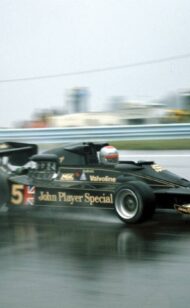
Mario Andretti F1 Profile & Career Stats

Former Formula 1 Driver
Mario Andretti
F1 career: 1968 - 1982
Driver Profile
| Country |  United States United States |
| Height | 1.70 meter / 5 feet 7 inch1.70 m / 5'7" |
| Place of Birth | Motovun |
| Date of Birth | Feb 28th 1940: 86 years old |
| Family | SonMichael Andretti |
| Season Entries | 14 (1968–1972, 1974–1982) |
| Car Number | 28 |
Championship Titles
- 1978Team Lotus13 clear of Ronnie Peterson
Full Career Statistics
| Drivers' Titles | 1 |
| Grand Prix Entries | 130 |
| Grand Prix Starts | 128 |
| Total Points | 180.00 |
| Avg. Points per GP | 1.38 |
| Grand Prix Wins | 12 (9,2%) |
| Wins from pole | 8 (6,2%) |
| Pole Positions | 18 (13,8%) |
| Front Row Starts | 24 (18,5%) |
| Avg. GP Grid | 8.4 |
| GP Podiums | 19 (14,6%) |
| GP Fastest Laps | 10 (7,7%) |
| GP Points Finish | 38 (29,2%) |
| Avg. GP Position | 5.7 |
| Hat-tricks | 2 (1,5%) |
| GP DNFs | 72 (55,4%) |
| Total GP Laps | 5.278 |
F1 Career Team History
Key Career Landmarks
Race1968 USA F1 Grand Prix1968 USA F1 GP 28 years, 221 days28y, 221d1982 Caesars Palace F1 Grand Prix1982 USA F1 GP 42 years, 209 days42y, 209d
1968 USA F1 Grand Prix1968 USA F1 GP 28 years, 221 days28y, 221d1982 Caesars Palace F1 Grand Prix1982 USA F1 GP 42 years, 209 days42y, 209dPole1968 USA F1 Grand Prix1968 USA F1 GP 28 years, 221 days28y, 221d 1982 Italian F1 Grand Prix1982 ITA F1 GP 42 years, 196 days42y, 196d
1968 USA F1 Grand Prix1968 USA F1 GP 28 years, 221 days28y, 221d1982 Italian F1 Grand Prix1982 ITA F1 GP 42 years, 196 days42y, 196dWin 1971 South African F1 Grand Prix1971 RSA F1 GP 31 years, 6 days31y, 6d
 1978 Dutch F1 Grand Prix1978 NED F1 GP 38 years, 180 days38y, 180d
1971 South African F1 Grand Prix1971 RSA F1 GP 31 years, 6 days31y, 6d1978 Dutch F1 Grand Prix1978 NED F1 GP 38 years, 180 days38y, 180dPodium 1970 Spanish F1 Grand Prix1970 ESP F1 GP 30 years, 50 days30y, 50d1982 Italian F1 Grand Prix1982 ITA F1 GP 42 years, 196 days42y, 196d
1970 Spanish F1 Grand Prix1970 ESP F1 GP 30 years, 50 days30y, 50d1982 Italian F1 Grand Prix1982 ITA F1 GP 42 years, 196 days42y, 196dFastest lap1971 South African F1 Grand Prix1971 RSA F1 GP 31 years, 6 days31y, 6d1978 Italian F1 Grand Prix1978 ITA F1 GP 38 years, 194 days38y, 194d
1971 South African F1 Grand Prix1971 RSA F1 GP 31 years, 6 days31y, 6d1978 Italian F1 Grand Prix1978 ITA F1 GP 38 years, 194 days38y, 194dPoints finish1970 Spanish F1 Grand Prix1970 ESP F1 GP 30 years, 50 days30y, 50d1982 Italian F1 Grand Prix1982 ITA F1 GP 42 years, 196 days42y, 196d
1970 Spanish F1 Grand Prix1970 ESP F1 GP 30 years, 50 days30y, 50d1982 Italian F1 Grand Prix1982 ITA F1 GP 42 years, 196 days42y, 196dWin from pole 1976 Japanese F1 Grand Prix1976 JPN F1 GP 36 years, 239 days36y, 239d1978 Dutch F1 Grand Prix1978 NED F1 GP 38 years, 180 days38y, 180d
1976 Japanese F1 Grand Prix1976 JPN F1 GP 36 years, 239 days36y, 239d1978 Dutch F1 Grand Prix1978 NED F1 GP 38 years, 180 days38y, 180dHat-trick 1977 French F1 Grand Prix1977 FRA F1 GP 37 years, 125 days37y, 125d1978 Spanish F1 Grand Prix1978 ESP F1 GP 38 years, 96 days38y, 96d
1977 French F1 Grand Prix1977 FRA F1 GP 37 years, 125 days37y, 125d1978 Spanish F1 Grand Prix1978 ESP F1 GP 38 years, 96 days38y, 96dF1 Career Finishing Positions
1st
12
2nd
2
3rd
5
4th
7
5th
6
6th
5
7th
7
8th
3
9th
1
10th
2
11th
1
12th
3
13th
1
DNF
72
DSQ
1
DNQ
1
DNS
1
DNF Did Not FinishDSQ DisqualifiedDNQ Did Not QualifyDNS Did Not Start
Performance Breakdown
Bio
Mario Andretti Biography
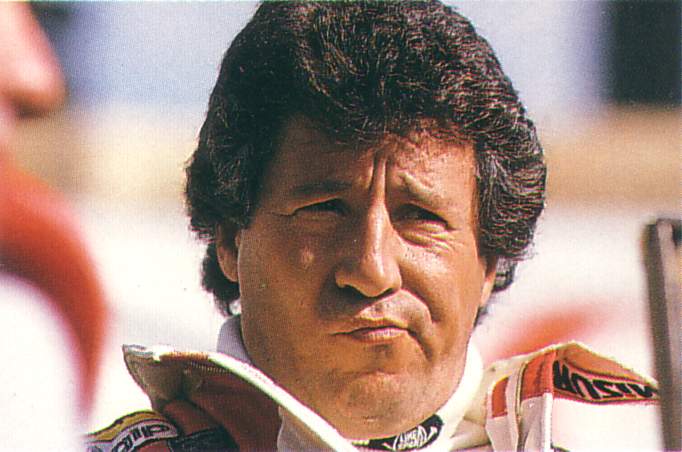
Mario Andretti at the USA West GP (1981)
Mario Andretti is the last F1 champion from the United States. He won the 1978 F1 Drivers' Championship and also the last World Constructors' Championship title for Team Lotus.
Born in Italy on the 28th of February of 1940 during World War II, Andretti and his family had to endure harsh times regarding overall comfortability as they had to live in a refugee during Mario’s childhood. During his teenage years, Mario and his twin brother Aldo had a passion for motorsport after they saw sections of a Mille Miglia race.
As a teenager, he attended the 1954 Italian Grand Prix, which Juan Manuel Fangio won with a one-lap gap over Mike Hawthorn, and his Formula 1 passion began. His motorsport craving continued and Alberto Ascari turned into his favourite driver. In a letter to his younger self published in 2016, Andretti described his admiration for the Italian Champion, the Mille Miglia, Monza, and the Italian Grand Prix as he said that was “all he thought about” as he was spending nine long days on a ship which his family boarded to move from Italy to the United States.
His motorsport journey continued in the United States as he and his brother started competing in stock cars on dirt oval tracks at 18 years of age after their High School time was done. On the dirt track at Nazareth, Pennsylvania, the Andretti brothers had success during their racing adventure, which was unknown to their parents. Their racing life hit their parents in harsh circumstances as Aldo got injured after a crash which threw him into a coma for 62 days due to a fractured skull, which unequivocally made their parents aware of the pair of twins’ racing career.
Aldo had another big accident in 1969 which provoked numerous facial injuries and ended his career.
Mario, who described racing as his “first passion” and his “only passion career-wise”, continued to compete all over the US and enjoyed much success. After starting his open-wheel career in the early 60s, Andretti went on to make his Champ car (now Indycar Series) debut in the 19th of April of 1964 at New Jersey.
After finishing his first Indycar season in 11th place, Andretti went on to win the 1965 and 1966 titles, although Indy 500 success evaded him in those two years. In the 1965 Indy 500, he finished third and earned Rookie of the year honours as he came home behind F1 champion Jim Clark and Parnelli Jones. Then, in 1966, he started the Indy 500 from Pole Position but he only lasted 27 laps in the race, which was won by F1 champion Graham Hill.
He finished second in the Indycar championship in 1967 and 1968, again with far-from-good Indy 500 results. He dominated Indycar in 1969 and finally won the Indy 500 after leading 116 laps. Also, from 1966 to 1969 he participated in various NASCAR events, winning the 1
967 Daytona 500 and making his F1 debut for Lotus on the 6th of October in the 1968 United States Grand Prix at Watkins Glen. He got off to a hot F1 start as he qualified on pole in his first race, although he could not convert it into a good result on Sunday.
His chance with Lotus had been promised by Lotus boss Colin Chapman since 1965 when a Clark won the Indy 500 and Chapman was impressed with Andretti’s performance. Chapman gave Andretti the chance to compete for Lotus and wanted him to take a full-time seat, but Andretti wanted to continue competing in the USA and remained racing in F1 from time to time.
He competed in eight Formula 1 Grands Prix in 1969 and 1970, achieving his first World Championship podium driving for March-Ford on the 19th of April of 1970 at Jarama during the Spanish Grand Prix.
For 1971, he competed for Ferrari in six Grands Prix, winning the first race of the year at South Africa on 6th March of 1971. He beat the World Champion-to-be Jackie Stewart by more than 20 seconds after starting in fourth place. He only participated in five other races for Ferrari in 1971.
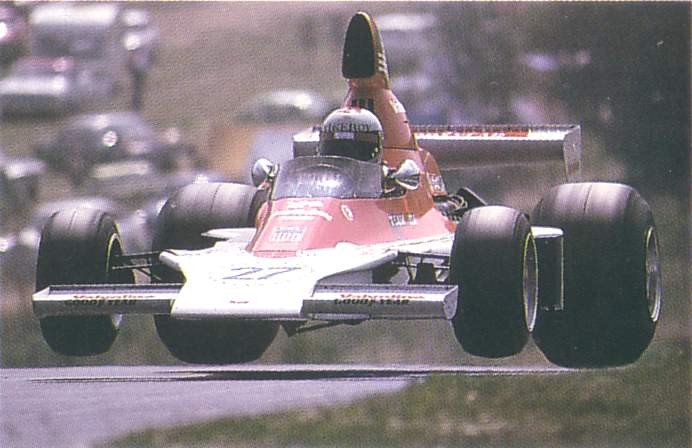
Mario Andretti in the Parnelli in France (1975)
In 1972, he had sporadic participation in F1 again as he contested only five races for Ferrari during the season. In the same year, he drove for Vel’s Parnelli Jones Racing in Indycar and the same team gave him the chance to compete in F1 in the final two races of 1974 (after not participating in any event from the 1973 season) and in most of the 1975 campaign. During those two years with Parnelli, Andretti’s best result was a fourth-place finish in the 1975 Swedish Grand Prix.
The 1976 campaign was pivotal for Andretti. The dream he thought of when watching his idol Alberto Ascari consisted of three missions: competing in F1, racing at Monza and becoming a World Champion. Only one step was needed for Andretti to fulfil his childhood dream and his Formula 1 road put Colin Chapman in his way once more.
Andretti finally drove a complete season in F1 with Lotus and a couple of races with Parnelli in 1976 (excluding the Monaco GP, which he missed to compete for the twelfth straight year in the Indy 500). The Italian-born American driver would finish the year with two third places and a victory in the last race of the year at Japan, which was the second of his F1 career.

Lotus 78 driven by Mario Andretti 2nd place (1978-1979)
Again, only one step needed to complete his dream and emulate his idol Ascari. In 1977, Andretti drove the first car with ground effect in F1 history, the Lotus 78. Andretti got close to his first Formula 1 title, but his charge fell short and he finished third in the standings despite being the driver with the most victories during the year with four. Also, Andretti won the 1977 Italian Grand Prix at Monza, which was his only win in the track where he fell in love with the sport as a young man.
Monza was waiting for him for an even bigger moment the following year, although it was a sad moment for him. In 1978, the Lotus 79 provided Andretti with the chance to dominate the F1 field. The American won six of the first 13 GPs of the calendar and arrived at Monza with the chance to clinch the title, but his teammate and close friend, Ronnie Peterson, was the only driver standing between him and his childhood desire.
In the next race, at Monza, Andretti started on Pole Position and Peterson in fifth place. Andretti finished the race in fifth place, but a horrifying crash in the opening laps involving Peterson sent the Swedish driver to the hospital, where he would die the next day. A sad moment for Andretti happened, as his dear friend death confirmed him as the World Champion. On a letter to his younger self, published in 2016, Andretti said that he could not celebrate his championship and that he would gladly trade it to have his friend back.
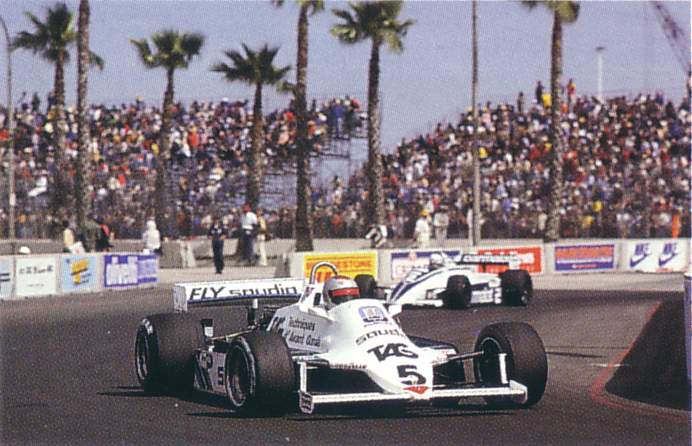
Mario Andretti driving the Williams FW08
Between 1979 and 1981, Andretti would not replicate his success from 1978. He drove for Lotus in 1979 and 1980, then switched to Alfa Romeo in 1981, but he only achieved a single podium during those three seasons.
Again, he moved from Formula 1 to his old roots in the US. He made his final two appearances in F1 with Williams and Ferrari in 1982. With Ferrari, he qualified on pole for the 1982 Italian GP at Monza and finished third, which was the final podium of his F1 career at a track where the motorsport fire started to burn inside his body when he was a teenager with big dreams.
After 1982, Mario went on to compete in the Indy 500 for the following 12 years in a row, although a Pole Position in the 1987 edition was the best he could do. In other categories, he became a class winner of the 24 Hours of Le Mans in the 1995 edition, where he finished second overall driving for Courage Compétition alongside Bob Wolleck and Éric Hélary.
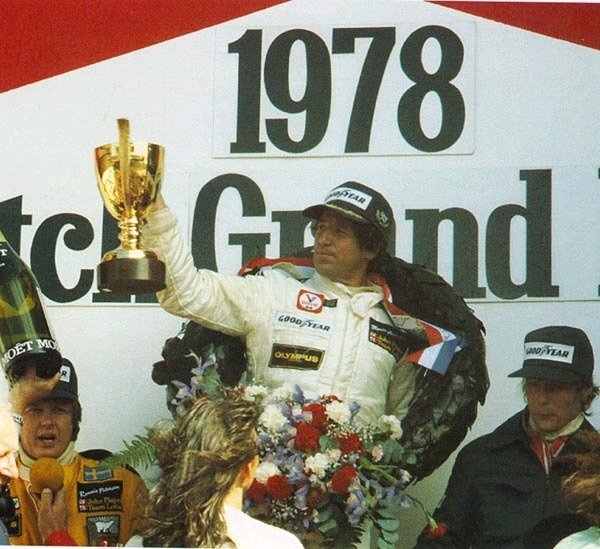
Mario Andretti's last win at Zandvoort (1978)
The last American to win an F1 World Championship and the last American to win a Grand Prix, the Andretti surname is a synonym of racing. Until today, the Andretti family continues to produce racing drivers, although none has been as huge as the young kid who manufactured a dream after watching Alberto Ascari drive around Monza and made his best to complete said plan.
A quote from Andretti himself would be the best way to describe such an incredible journey:
“Desire is the key to motivation, but it's determination and commitment to an unrelenting pursuit of your goal - a commitment to excellence - that will enable you to attain the success you seek”.
Official Mario Andretti website: https://www.marioandretti.com
Cars
Mario Andretti F1 cars15 cars · 1968–1982All F1 cars →
Seasons
Mario Andretti Championship Results
1× World Championship1978–1978 · Team Lotus
One title, won in 1978 with Team Lotus.
- 1978Team Lotus64 pts13 clear of Ronnie Petersonsealed at 1978 Italian F1 GP
19th
1982
17th
1981
20th
1980
12th
1979
1st
1978
3rd
1977
6th
1976
14th
1975
25th
1974
12th
1972
8th
1971
15th
1970
31st
1969
37th
1968
Mario Andretti F1 Seasons Summary
| Year | Team | Engine | GP | 1st | 2nd | 3rd | Pod | Pole | Laps | FL | Avg Pts | Points |
|---|---|---|---|---|---|---|---|---|---|---|---|---|
| 1982 |
Ferrari Williams Williams |
Ferrari Ford | 3 | 0 | 0 | 1 | 1 | 1 | 97 | 0 | 1.33 | 4 |
| 1981 |
 Alfa Romeo Alfa Romeo |
Alfa Romeo | 15 | 0 | 0 | 0 | 0 | 0 | 712 | 0 | 0.20 | 3 |
| 1980 |
Team Lotus |
Ford | 14 | 0 | 0 | 0 | 0 | 0 | 516 | 0 | 0.07 | 1 |
| 1979 |
Team Lotus |
Ford | 15 | 0 | 0 | 1 | 1 | 0 | 546 | 0 | 0.93 | 14 |
| 1978 🏆 |
Team Lotus |
Ford | 16 | 6 | 1 | 0 | 7 | 8 | 870 | 3 | 4.00 | 64 |
| 1977 |
Team Lotus |
Ford | 17 | 4 | 1 | 0 | 5 | 7 | 806 | 4 | 2.76 | 47 |
| 1976 |
Parnelli Team Lotus |
Ford Ford | 15 | 1 | 0 | 2 | 3 | 1 | 605 | 1 | 1.47 | 22 |
| 1975 |
Parnelli |
Ford | 12 | 0 | 0 | 0 | 0 | 0 | 373 | 1 | 0.42 | 5 |
| 1974 |
Parnelli |
Ford | 2 | 0 | 0 | 0 | 0 | 0 | 83 | 0 | 0.00 | 0 |
| 1972 |
Ferrari |
Ferrari | 5 | 0 | 0 | 0 | 0 | 0 | 234 | 0 | 0.80 | 4 |
| 1971 |
Ferrari |
Ferrari | 5 | 1 | 0 | 0 | 1 | 0 | 206 | 1 | 2.40 | 12 |
| 1970 |
March |
Ford | 5 | 0 | 0 | 1 | 1 | 0 | 164 | 0 | 0.80 | 4 |
| 1969 |
Team Lotus |
Ford | 3 | 0 | 0 | 0 | 0 | 0 | 34 | 0 | 0.00 | 0 |
| 1968 |
Team Lotus |
Ford | 1 | 0 | 0 | 0 | 0 | 1 | 32 | 0 | 0.00 | 0 |
Races
Wins
Podiums
Poles
Teammates
News
Latest Mario Andretti News

On This Day in F1 History: Peterson's Final Masterclass
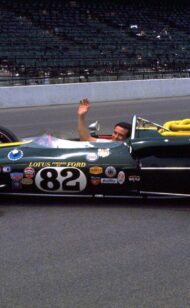
F1 Champions Who Conquered the Indy 500
2
Cadillac F1 Team: Perez's Response to 'Rusty' Comment from Andretti
3
2026 F1 Launches: Cadillac to Unveil Livery During Super Bowl!

Could This Be the End of Piastri's McLaren Dream?
4
Inside Ferrari's Struggles: Andretti Challenges Vasseur's Leadership
13
F1 Beyond The Grid: Mario Andretti Discusses Racing History and
2Inside the Negotiations: Why Sergio Perez's Contract with Cadillac Remains

Sabbatical Surprise: Sergio Perez and F1's Open Doors
1
Read more Mario Andretti News »
Mario Andretti — Frequently Asked Questions
When did Mario Andretti start racing in Formula 1?
Mario Andretti started racing in Formula 1 in 1968.
Is Mario Andretti still racing in Formula 1?
No, Mario Andretti last competed in Formula 1 in 1982.
How many Formula 1 races has Mario Andretti won?
Mario Andretti has won 12 Formula 1 races.
How many F1 World Championships has Mario Andretti won?
Mario Andretti has won 1 Formula 1 World Drivers' Championship (1978).
How many F1 podiums does Mario Andretti have?
Mario Andretti has finished on the podium 19 times in Formula 1.
When did Mario Andretti win their first F1 race?
Mario Andretti won their first Formula 1 race at the 1971 South African F1 GP.
What nationality is Mario Andretti?
Mario Andretti is American.
Which teams has Mario Andretti driven for in Formula 1?
Mario Andretti has driven for March, Parnelli, Team Lotus, Alfa Romeo, Ferrari and Williams in Formula 1.
How many F1 races has Mario Andretti entered?
Mario Andretti has competed in 130 Formula 1 Grands Prix.


