









Mark Webber F1 Profile & Career Stats

Former Formula 1 Driver
Mark Webber
F1 career: 2002 - 2013
Full Career Statistics
| Drivers' Titles | 0 |
| Grand Prix Entries | 217 |
| Grand Prix Starts | 215 |
| Total Points | 1047.50 |
| Avg. Points per GP | 4.83 |
| Grand Prix Wins | 9 (4,1%) |
| Wins from pole | 4 (1,8%) |
| Pole Positions | 13 (6,0%) |
| Front Row Starts | 37 (17,1%) |
| Avg. GP Grid | 8.3 |
| GP Podiums | 42 (19,4%) |
| GP Fastest Laps | 19 (8,8%) |
| GP Points Finish | 112 (51,6%) |
| Avg. GP Position | 6.6 |
| GP DNFs | 57 (26,3%) |
| Total GP Laps | 10.978 |
F1 Career Team History
Key Career Landmarks
Race 2002 Australian F1 Grand Prix2002 AUS F1 GP 25 years, 188 days25y, 188d
 2013 Brazilian F1 Grand Prix2013 BRA F1 GP 37 years, 89 days37y, 89d
2002 Australian F1 Grand Prix2002 AUS F1 GP 25 years, 188 days25y, 188d2013 Brazilian F1 Grand Prix2013 BRA F1 GP 37 years, 89 days37y, 89dPole 2009 German F1 Grand Prix2009 GER F1 GP 32 years, 319 days32y, 319d
 2013 Abu Dhabi F1 Grand Prix2013 UAE F1 GP 37 years, 68 days37y, 68d
2009 German F1 Grand Prix2009 GER F1 GP 32 years, 319 days32y, 319d2013 Abu Dhabi F1 Grand Prix2013 UAE F1 GP 37 years, 68 days37y, 68dWin2009 German F1 Grand Prix2009 GER F1 GP 32 years, 319 days32y, 319d 2012 British F1 Grand Prix2012 GBR F1 GP 35 years, 316 days35y, 316d
2009 German F1 Grand Prix2009 GER F1 GP 32 years, 319 days32y, 319d2012 British F1 Grand Prix2012 GBR F1 GP 35 years, 316 days35y, 316dPodium 2005 Monaco F1 Grand Prix2005 MON F1 GP 28 years, 268 days28y, 268d2013 Brazilian F1 Grand Prix2013 BRA F1 GP 37 years, 89 days37y, 89d
2005 Monaco F1 Grand Prix2005 MON F1 GP 28 years, 268 days28y, 268d2013 Brazilian F1 Grand Prix2013 BRA F1 GP 37 years, 89 days37y, 89dFastest lap 2009 Hungarian F1 Grand Prix2009 HUN F1 GP 32 years, 333 days32y, 333d2013 Brazilian F1 Grand Prix2013 BRA F1 GP 37 years, 89 days37y, 89d
2009 Hungarian F1 Grand Prix2009 HUN F1 GP 32 years, 333 days32y, 333d2013 Brazilian F1 Grand Prix2013 BRA F1 GP 37 years, 89 days37y, 89dPoints finish2002 Australian F1 Grand Prix2002 AUS F1 GP 25 years, 188 days25y, 188d2013 Brazilian F1 Grand Prix2013 BRA F1 GP 37 years, 89 days37y, 89d
2002 Australian F1 Grand Prix2002 AUS F1 GP 25 years, 188 days25y, 188d2013 Brazilian F1 Grand Prix2013 BRA F1 GP 37 years, 89 days37y, 89dWin from pole2009 German F1 Grand Prix2009 GER F1 GP 32 years, 319 days32y, 319d2012 Monaco F1 Grand Prix2012 MON F1 GP 35 years, 274 days35y, 274d
2009 German F1 Grand Prix2009 GER F1 GP 32 years, 319 days32y, 319d2012 Monaco F1 Grand Prix2012 MON F1 GP 35 years, 274 days35y, 274dF1 Career Finishing Positions
1st
9
2nd
16
3rd
17
4th
17
5th
10
6th
14
7th
16
8th
12
9th
12
10th
8
11th
9
12th
8
13th
2
14th
3
15th
1
16th
1
17th
1
DNF
57
NC
2
DNS
2
DNF Did Not FinishNC Not ClassifiedDNS Did Not Start
Performance Breakdown
Bio
Mark Webber Biography
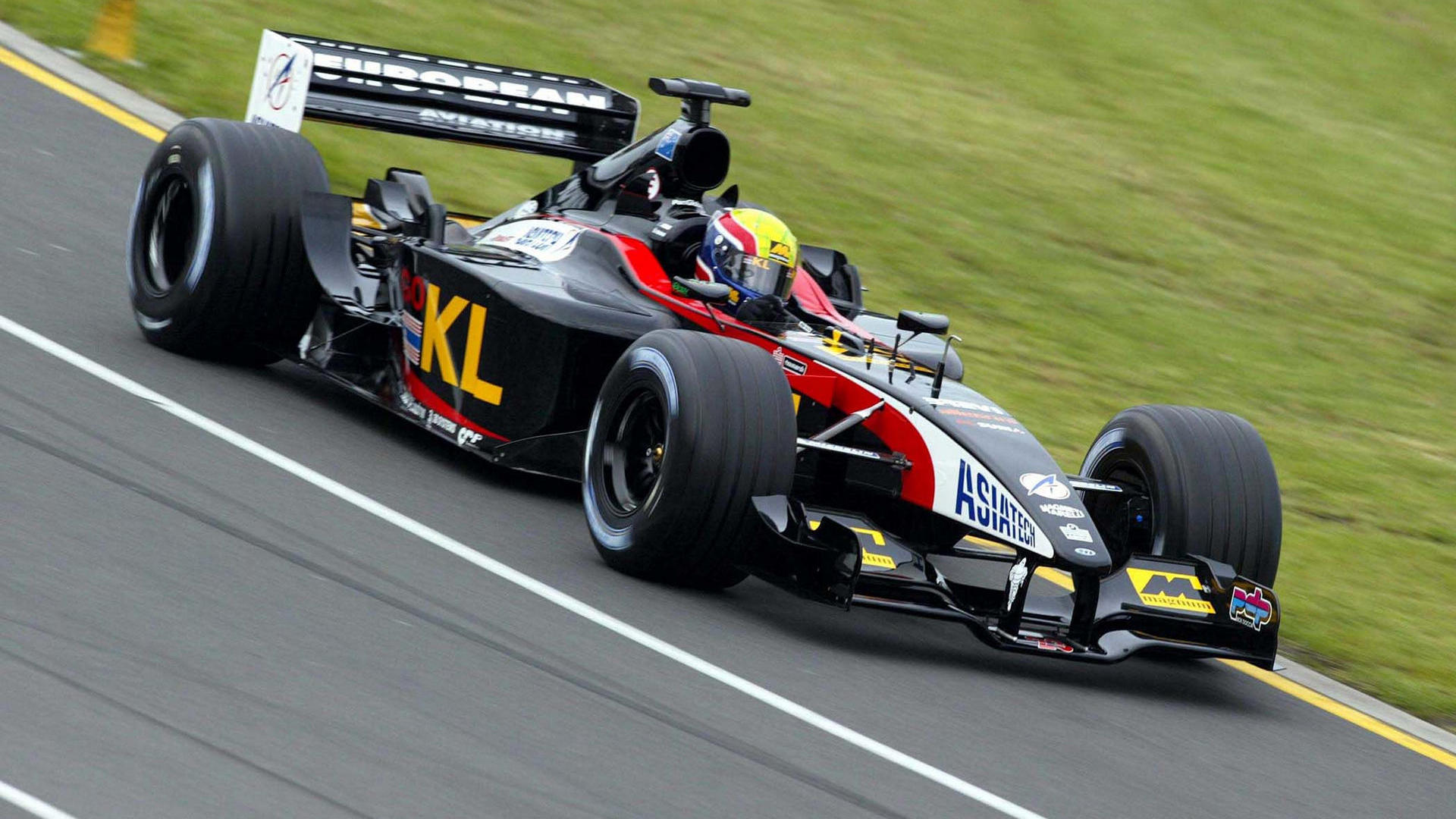
Mark Webber finished 5th in his first F1 GP in Australia with the Minardi PS02
The term ‘grit and determination’ is a fine way of describing former racer Mark Webber. The Australian battled hard throughout his career to get to the top of the sport and fighting for world championships. He drove for teams at the front, middle and back of the grid in a complete career.
Eventually the lack of success he was getting at Red Bull saw Webber retire at the end of 2013. He was one of the most popular drivers on the grid and will be badly missed. His career shows that even if you’re not hand-picked for the top, you can still make it.
Webber initially signed for minnows Minardi in 2002, the slowest car on the grid. Despite this he scored points in his very first race, his home grand prix in Australia. Webber benefited from other drivers problems and finished 5th in a remarkable performance. The rest of his debut season was spent struggling towards the back, but Webber equipped himself well enough to earn a move to Jaguar in 2003.
The Australian showed the world how good he was by qualifying third in the season’s third race in Brazil and went on to score points in five out of six races in Europe. The Australian went on to have an impressive year and won Autosport’s ‘Driver of the Year’ award, beating Michael Schumacher, Kimi Raikkonen and Juan Pablo Montoya. This award was justified by the remarkable statistic that showed that Webber has yet to be out qualified by his team mate at any grand prix in his two years.
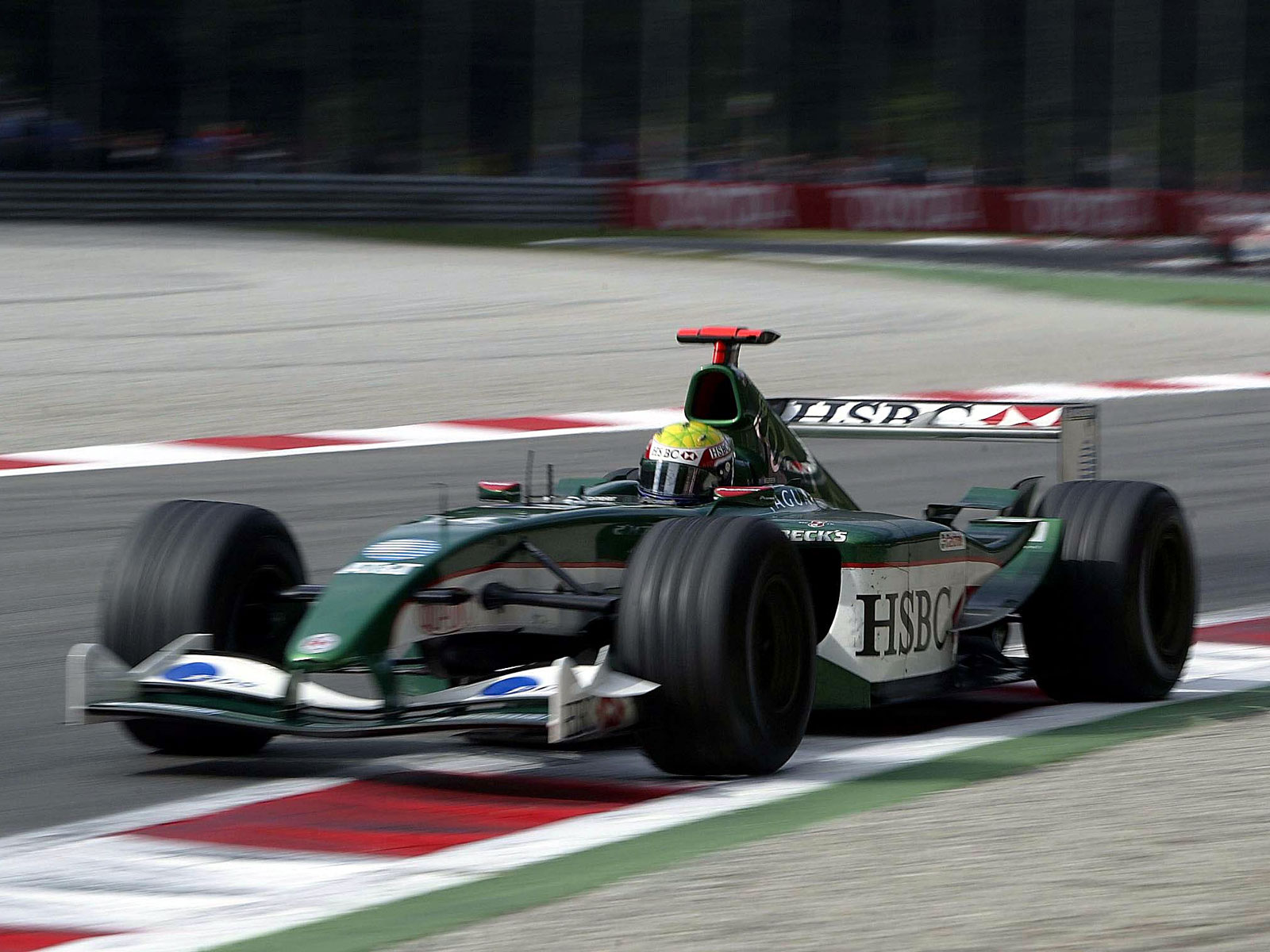
Mark Webber racing at Monza with his Jaguar R4 (2003)
Jaguar failed to progress in 2004 and reliability proved to be the team’s biggest problem as Webber retired eight times. A disappointing seven points were collected that season, and Webber decoded enough was enough. In 2005 he joined Williams. The faster car helped Webber score more consistent points, and his first podium materialised with a third placed finish in Monaco. His best haul of 36 points and a tenth placed finish in the drivers’ standings capped an impressive year.
An unwelcomed pattern was emerging for Webber as after every good season came a bad one. 2006 saw arguably the worst Williams car in a decade as Webber and rookie team mate Nico Rosberg scored just 11 points between them. Mid-way through the season a deal was struck for Webber to join Red Bull, a new team languishing in mid-table. The potential to work alongside design genius Adrian Newey was the driving force behind Webber’s decision.
Initially it hadn't looked like Webber had progressed much further up the grid, as he had an up and down season. A second career podium in the wet European Grands Prix at the Nurburgring was cancelled out by his crash in Japan where he was fighting for a maiden win. While running second in the torrential conditions behind Lewis Hamilton’s struggling McLaren the safety car came out. Hamilton braked severely while following the car and Sebastian Vettel, running third, didn't anticipate the change of speed and collided with Webber’s rear taking them both out of the race.
2008 was another mediocre season with Webber finishing with 21 points, but with the dramatic rule changes arriving in 2009, Red Bull fancied their chances at producing a title winning car. Webber was joined by Vettel, and immediately the car was a hit as Vettel won the Chinese Grand Prix in the season’s third race. Webber followed his team mate home in second and secured his best ever finish.
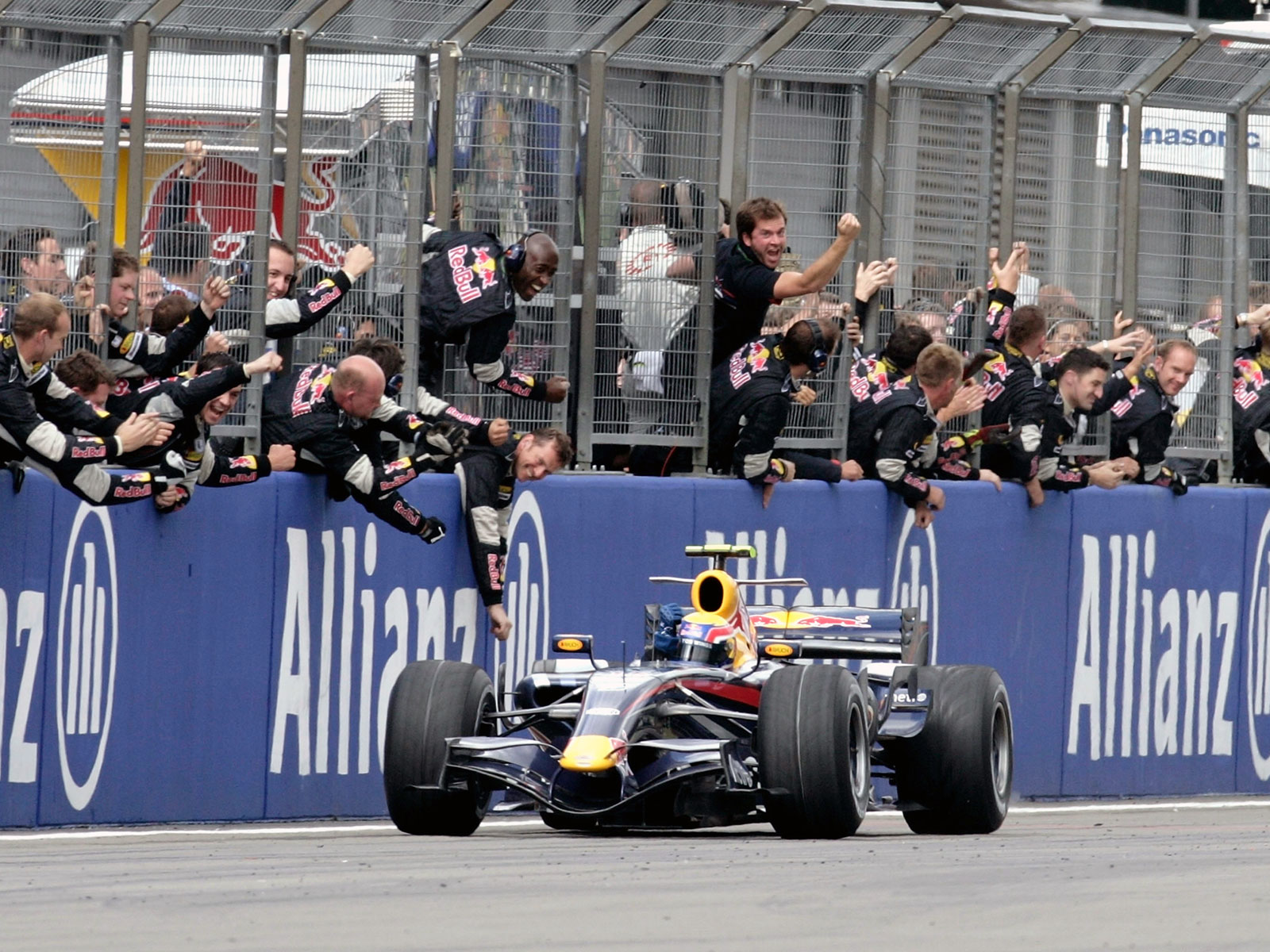
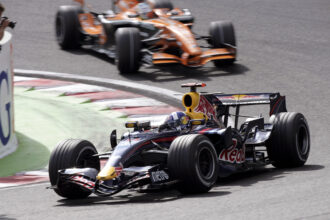
Webber's first Red Bull Nurburgring 2007
Consistently, Webber scored high points behind the dominant Jenson Button in the Brawn car. Red Bull improved their car as the season progressed and in Germany Webber set his first pole position. An eventful race, which saw him recover from a drive through penalty, saw the 32 year-old record his first Formula One win. A string of podiums saw him sit second in the championship, but then a poor patch saw him eventually finish 4th. A second race win in Brazil followed at the end of the season. More of the same was to follow.
Red Bull entered 2010 as favourites for the title; however Sebastian Vettel was hotly tipped to lead their charge over Webber. The Aussie’s renowned grit and determination saw him out race Vettel for much of the season as he showed his true class. Five pole positions and four race wins in Spain, Monaco, Britain and Hungary, with the first two being a memorable back to back triumph, saw Webber lead the championship at the half way stage. However the wins dried up and he subsequently fell away to finish third, just 14 points behind champion Vettel.
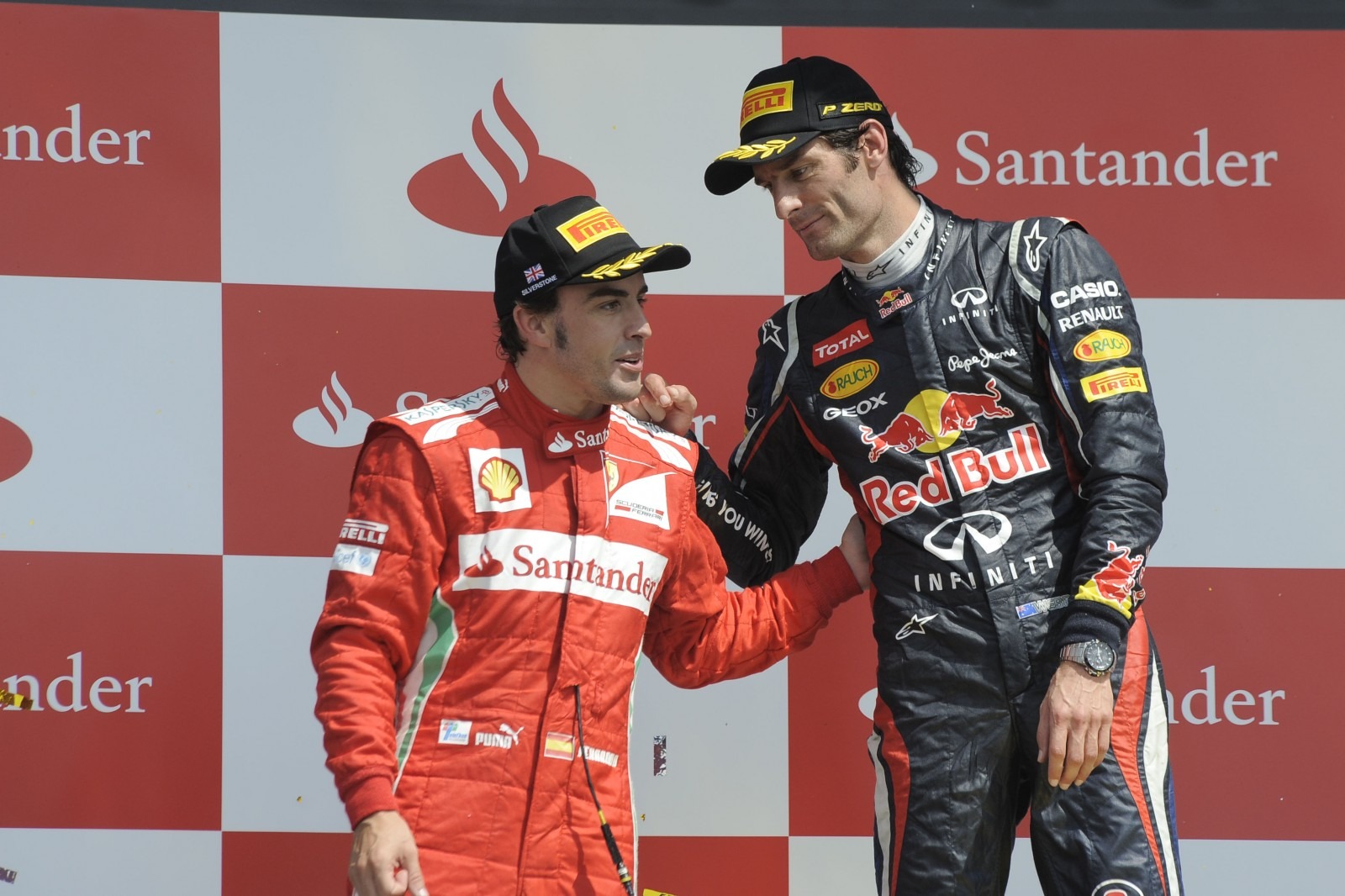
Mark Webber & Fernando Alonso on the podium
Critics believe this was his finest year as Vettel strolled to the championship in 2011 as Webber failed to get anywhere near him. Just one win, in Brazil, in comparison to Vettel’s 11 told the whole story. In 2012 again the Australian looked to be in with a shout after a positive first half of the season, which saw wins in Monaco and Britain. But a familiar story of poor form and bad luck saw any realistic challenge disappear.
As time went on it became clear that Vettel had a unique understanding of the rules and that Webber couldn't quite adjust. His preference for the older rules which were in place when he first entered the sport was well-known. In 2013 he looked disillusioned. Vettel and Red Bull were the class of the field again. The margins between the team-mates were small but the German always had the upper-hand. Webber failed to win a race. Vettel won 13 and a fourth straight championship.
The decision to retire wasn't surprising. Webber clearly struggled in the last 18 months and the incident in Malaysia in 2013, when he was overtaken by Vettel in a battle for the win, when the team said he wouldn't, clearly had an effect. He bowed out with nine wins and 13 poles. Not bad for a guy who started at Minardi.
Cars
Seasons
Mark Webber F1 Championship Season Results
3rd
2013
6th
2012
3rd
2011
3rd
2010
4th
2009
11th
2008
12th
2007
14th
2006
10th
2005
13th
2004
10th
2003
16th
2002
Mark Webber F1 Seasons Summary
| Year | Team | Engine | GP | 1st | 2nd | 3rd | Pod | Pole | Laps | FL | Avg Pts | Points |
|---|---|---|---|---|---|---|---|---|---|---|---|---|
| 2013 |
 Red Bull Red Bull |
 Renault Renault | 19 | 0 | 5 | 3 | 8 | 2 | 1049 | 5 | 10.47 | 199 |
| 2012 |
Red Bull |
Renault | 20 | 2 | 1 | 1 | 4 | 2 | 1131 | 1 | 8.95 | 179 |
| 2011 |
Red Bull |
Renault | 19 | 1 | 2 | 7 | 10 | 3 | 1084 | 7 | 13.58 | 258 |
| 2010 |
Red Bull |
Renault | 19 | 4 | 4 | 2 | 10 | 5 | 1043 | 3 | 12.74 | 242 |
| 2009 |
Red Bull |
Renault | 17 | 2 | 4 | 2 | 8 | 1 | 916 | 3 | 4.09 | 69.5 |
| 2008 |
Red Bull |
Renault | 18 | 0 | 0 | 0 | 0 | 0 | 998 | 0 | 1.17 | 21 |
| 2007 |
Red Bull |
Renault | 17 | 0 | 0 | 1 | 1 | 0 | 749 | 0 | 0.59 | 10 |
| 2006 |
Williams |
 Toyota Toyota | 18 | 0 | 0 | 0 | 0 | 0 | 671 | 0 | 0.39 | 7 |
| 2005 |
Williams |
BMW | 18 | 0 | 0 | 1 | 1 | 0 | 947 | 0 | 2.00 | 36 |
| 2004 |
Jaguar |
Cosworth | 18 | 0 | 0 | 0 | 0 | 0 | 787 | 0 | 0.39 | 7 |
| 2003 |
Jaguar |
Cosworth | 16 | 0 | 0 | 0 | 0 | 0 | 822 | 0 | 1.06 | 17 |
| 2002 |
 Minardi Minardi |
Asiatech | 16 | 0 | 0 | 0 | 0 | 0 | 781 | 0 | 0.13 | 2 |
Races
Wins
Podiums
Poles
Teammates
News
Latest Mark Webber News

Mark Webber's 2026 Interview About his F1 Career And More

On This Day in 2012: Webber's Final F1 Win

On This Day in F1 History: Vettel and Webber's Istanbul
Red Bull RB7 Roars Again at French Historic GP

Oscar Piastri Reveals Truth Behind Mark Webber Speculation

Piastri-Webber Rumoured Tension: McLaren Driver Defends Management Shift

Piastri-Webber Rumours: McLaren's F1 Driver Changing His Inner Circle?

Ralf Schumacher Blasts Webber's Job as Piastri's Manager
3
Inside Piastri's Struggles: Webber's Call to Rise Again
Read more Mark Webber News »
Mark Webber — Frequently Asked Questions
When did Mark Webber start racing in Formula 1?
Mark Webber started racing in Formula 1 in 2002.
Is Mark Webber still racing in Formula 1?
No, Mark Webber last competed in Formula 1 in 2013.
How many Formula 1 races has Mark Webber won?
Mark Webber has won 9 Formula 1 races.
How many F1 podiums does Mark Webber have?
Mark Webber has finished on the podium 42 times in Formula 1.
When did Mark Webber win their first F1 race?
Mark Webber won their first Formula 1 race at the 2009 German F1 GP.
What nationality is Mark Webber?
Mark Webber is Australian.
Which teams has Mark Webber driven for in Formula 1?
Mark Webber has driven for Minardi, Jaguar, Williams and Red Bull in Formula 1.
How many F1 races has Mark Webber entered?
Mark Webber has competed in 217 Formula 1 Grands Prix.


