Audi's new gear ratios arrive at Monza after 24 weeks
1





| Country |  Germany Germany |
| Season Entries | 2 (2026) |
| Total Drivers | 2 |
| Best Qualifying | 8th - 2026 Belgian F1 GP |
| Best Result | 8th - (3 times) |
| Team Principal | Mattia Binotto |
| Drivers |  Gabriel Bortoleto Gabriel Bortoleto Nico Hülkenberg Nico Hülkenberg |
| Originated from | Sauber (2026) |
| Constructors' Titles | 0 |
| F1 Drivers' Titles | 0 |
| Grand Prix Entries | 12 |
| Grand Prix Starts | 12 |
| Total Points | 16 |
| Avg. Points per GP | 1,33 |
| Grand Prix Wins | 0 |
| Pole Positions | 0 |
| GP Podiums | 0 |
| GP Fastest Laps | 0 |
| GP DNFs | 3 |
| Total GP Laps | 1222 |
Audi merchandise
All 31 Audi items
 Save 20%
Audi F1 adidas Elevated Crew Sweatshirt
 Save 20%
Audi F1 adidas Elevated Graphic T-Shirt
 Save 20%
Audi F1 2026 Replica Team T-Shirt
 Save 20%
Audi F1 adidas DNA Joggers - Black
27. Nico Hülkenberg

| Drivers' Titles | 0 |
| Grand Prix Entries | 266 |
| Grand Prix Starts | 263 |
| Total Points | 626.00 |
| Avg. Points per GP | 2.35 |
| Grand Prix Wins | 0 |
| Pole Positions | 1 (0,4%) |
| Front Row Starts | 2 (0,8%) |
| Avg. GP Grid | 11.2 |
| GP Podiums | 1 (0,4%) |
| GP Fastest Laps | 2 (0,8%) |
| GP Points Finish | 121 (45,5%) |
| Avg. GP Position | 10.4 |
| GP DNFs | 48 (18,0%) |
| Total GP Laps | 13.687 |
| Drivers' Titles | 0 |
| Grand Prix Entries | 36 |
| Grand Prix Starts | 35 |
| Total Points | 29.00 |
| Avg. Points per GP | 0.81 |
| Grand Prix Wins | 0 |
| Pole Positions | 0 |
| Avg. GP Grid | 13.7 |
| GP Podiums | 0 |
| GP Fastest Laps | 0 |
| GP Points Finish | 8 (22,2%) |
| Avg. GP Position | 12.4 |
| GP DNFs | 5 (13,9%) |
| Total GP Laps | 1.907 |
| Driver | GP | 1st | 2nd | 3rd | Pod | Pole | Laps | FL | PTS |
|---|---|---|---|---|---|---|---|---|---|
| Nico Hülkenberg | 11 | 0 | 0 | 0 | 0 | 0 | 542 | 0 | 6 |
 Gabriel Bortoleto Gabriel Bortoleto | 11 | 0 | 0 | 0 | 0 | 0 | 680 | 0 | 10 |


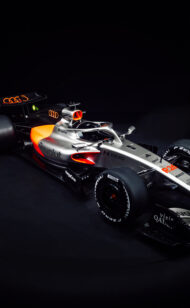
Indoor studio shot, exterior, front, detail of nose and front wing
Before Audi ever put its name on a Formula 1 entry list, the four rings had already been part of Grand Prix racing’s most dramatic era.
Those rings come from Auto Union, the 1930s German manufacturer group formed by Audi, DKW, Horch and Wanderer. Auto Union’s “Silver Arrows” became the stuff of legend, trading victories with Mercedes in the pre-war European championship years. It’s not “Formula 1” in the modern, post-1950 sense, but it is the direct historical root of Audi’s racing identity, and it explains why Audi’s eventual arrival in F1 has always felt more like a return than a debut.
Auto Union entered top-level Grand Prix racing in 1934, during a period when rules were changing quickly, national pride was heavily entwined with motorsport, and the cars were brutally fast for their time.
The headline technical choice was bold: mid-engine layout (the engine sat behind the driver), a concept that would only become universal in F1 decades later. Auto Union’s GP cars are commonly referred to as the Type A, B, C and D (successive designs across the 1934–1939 period). They were powerful, difficult, and spectacular, the sort of machines that made heroes and occasionally swallowed them whole.
Auto Union’s driver roster included some of the era’s biggest names. Bernd Rosemeyer became the team’s star and won the 1936 European Championship for drivers. Auto Union also fielded Tazio Nuvolari and Achille Varzi, among others. Against Mercedes, it was a genuine heavyweight fight, one that shaped the mythology of the “Silver Arrows” long before the modern F1 paddock even existed.
The Second World War effectively ended that first Grand Prix chapter. Auto Union’s post-war story became complicated, factories, borders and ownership all shifted, but the corporate lineage eventually ran into the Volkswagen Group, and the Audi name was revived for new road cars in the mid-1960s.
Motorsport didn’t disappear from Audi’s DNA in that time; it simply changed form. And once Audi returned in earnest, it did so with a very particular habit: turning up with clever engineering and the patience to make it work.
Audi’s modern racing identity is built less on romantic nostalgia and more on results.
Rallying is the obvious starting point. Audi’s quattro system became a motorsport landmark, and Audi won major honours in the World Rally Championship in the early 1980s, including the 1982 manufacturers’ title, and both drivers’ and manufacturers’ titles in 1984.
Then came a wide spread of circuit racing programmes:
That endurance record matters when talking about F1, because it shows the pattern: Audi tends to commit seriously when it chooses a world championship stage, with facilities, staffing, and long-term investment, not just branding.
Audi’s official F1 entry is tied directly to the 2026 regulations, which reshape the power-unit formula and push the sport harder toward efficiency and sustainability.
Key features of the 2026 power-unit direction (as defined by the sport’s published plans up to my August 2025 knowledge cutoff) include:
For a manufacturer like Audi, which has long marketed efficiency, electrification and technology transfer, 2026 created a cleaner strategic fit than many previous F1 eras.
Audi publicly confirmed it would enter Formula 1 as a manufacturer for 2026 in August 2022, committing to develop its own power unit.
The project was set up with a clear split-site approach:
Audi also moved to take ownership control of Sauber’s F1 operation as part of building a full works team. The intention, as stated in the project’s public direction, was not merely to badge an existing outfit, but to integrate the programme as a manufacturer entry in the new rules cycle.
Sauber is not a random choice. The team has decades of F1 experience, a modern factory in Hinwil, and a history of punching above its weight when its structure is stable. It also gives Audi something priceless in F1: an existing operational backbone, rather than trying to build a team from scratch.
If you define “history” strictly as Audi racing in the Formula 1 World Championship before 2026, the honest answer is simple: Audi hasn’t previously competed in F1 as a works team.
But if you define it the way motorsport fans tend to, heritage, engineering identity, and the long runway that leads to a factory entry, then Audi’s F1 story has been building for nearly a century:
So when Audi arrives on the F1 grid in 2026, it won’t be pretending to be something it isn’t. It will be a newcomer to the championship, yes, but not a newcomer to the kind of engineering war that F1 becomes when the rules reset.







Read all Audi F1 News »
| Pos. | F1 Constructors | CT |
|---|---|---|
| 1 |  Ferrari Ferrari | 16 |
| 2 |  McLaren McLaren | 10 |
| 3 | Williams | 9 |
| 4 | Mercedes | 8 |
| 5 | Team Lotus | 7 |
| 6 |  Red Bull Red Bull | 6 |
| 7 |  Renault Renault | 2 |
| 8 | Brabham | 2 |
| 9 | Cooper-Climax | 2 |
| 10 | Benetton | 1 |
| Pos. | F1 Teams | Points | |
|---|---|---|---|
| 1 | | Mercedes | 425 |
| 2 | | Ferrari | 338 |
| 3 | | McLaren | 263 |
| 4 | | Red Bull | 186 |
| 5 | | Racing Bulls | 66 |
| 6 | | Alpine | 63 |
| 7 |  | Haas | 21 |
| 8 | | Audi | 16 |
| 9 | | Williams | 11 |
| 10 | | Aston Martin | 3 |