








McLaren MP4/31: 2016 F1 Car Specs & Stats
5th
Best Finish
3rd
Best Quali
76
Points
1
Fastest Lap
Car Profile
Power Unit & Tyres
Drivers of the McLaren MP4/31
2016 Finishing Positions
5th
2
6th
2
7th
4
8th
1
9th
4
10th
4
11th
2
12th
5
13th
3
14th
2
16th
2
18th
2
DNF
9
DNF Did Not Finish
2016 Race by Race
21 Grands Prix


DNF–126DNF511DNF181371271477165131010
14DNF131099DNF11612DNF8DNF12DNF91891216DNF
–10–––––––––––––––––––
1Podium 7Points 14Outside the points DNFNot classified
McLaren model cars
All 7 McLaren items Save 50%
McLaren 1:14 Scale 2024 RC CAR
LEGO® McLaren Formula 1 Race Car 42141
McLaren Mastercard F1 Team Oscar Piastri Lego Helmet

F1® LEGO® Driver with McLaren Race Car
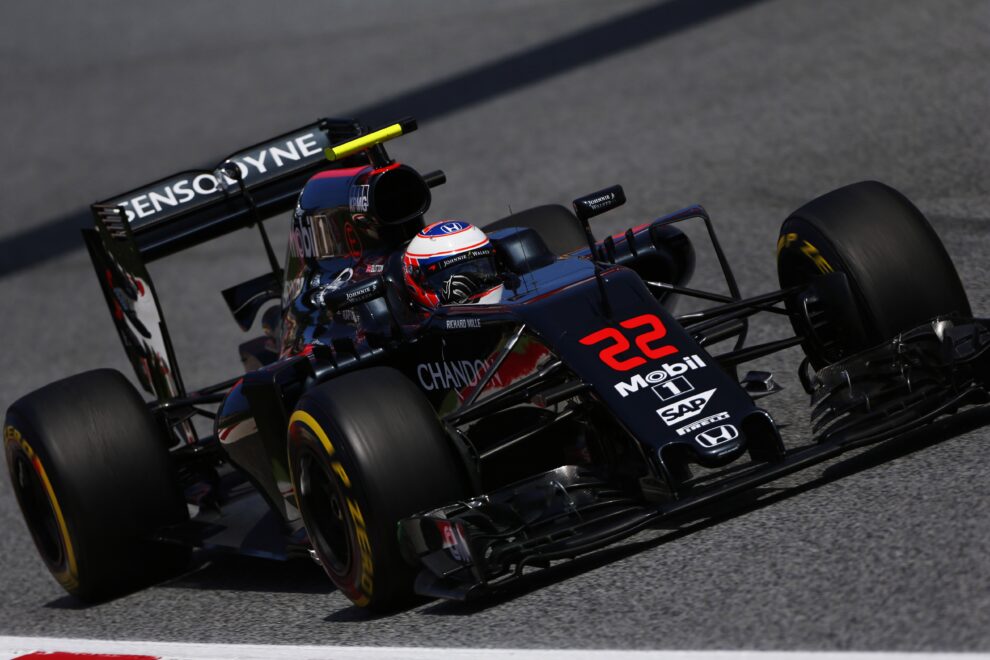
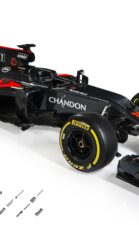
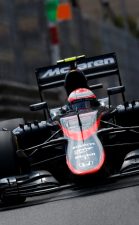
McLaren's F1 car for 2016
Improved stability and actually seeing the chequered flag was the headline for McLaren-Honda in the 2016 F1 season and, in many ways, that was by design. After the bruising first year of the reunion, both sides treated season two as “Year One, properly”, armed at last with real-world data and a clearer understanding of what had gone wrong.
RA616H: fixing what “Size Zero” had sacrificed
Honda’s 2016 power unit (RA616H) was a step on from the RA615H, targeting the areas that had been compromised to make McLaren’s aggressive “Size Zero” packaging possible. The big changes were focused on airflow and combustion efficiency.
The intake and exhaust systems, previously squeezed for space, were reworked for better efficiency, helping claw back performance. Honda also raised the surge tank (which houses the variable intake system) by 30mm, allowing smoother airflow into the combustion chamber. It cost McLaren some chassis volume, but the team bought into the trade-off and worked to recover competitiveness elsewhere.
Another key change came at the injectors. Moving them from the side to the top improved combustion efficiency, with the knock-on benefit of better power output. None of this transformed the RA616H into a class leader overnight, but it addressed the fundamentals that had held the 2015 package back.
Reliability first, pace later
If there was one area Honda attacked with maximum urgency, it was reliability. Using the previous season’s failures as a roadmap, Honda tightened quality control, prioritised durability testing, and generally treated every component as if it had personally embarrassed the company.
The result was a dramatic improvement in robustness. From pre-season testing, the difference was visible: the RA616H ran more consistently, and the overall mood shifted from survival mode to something closer to cautious confidence. Inside the project, the phrase “practically our first year” did the rounds, an admission that 2015 had been as much a learning exercise as a competitive campaign.
That said, this was still an early-stage design: effectively a minor-change evolution of the RA615H. Its output and control systems simply weren’t yet at the level of the top power units, and that ceiling remained a problem as the year unfolded.
MP4-31: evolution, not revolution
McLaren’s MP4-31 followed a similar philosophy. With major regulation changes looming for 2017, most teams chose to evolve their existing cars rather than burn resources on clean-sheet concepts. McLaren did the same: the MP4-31 was a modest development of the MP4-30.
The car retained the short nose introduced mid-season the year before, while the most obvious visible tweak was the addition of vertical slits in the wing-support stays. Front and rear suspension concepts carried over, although the layout and sizing were subtly adjusted to improve airflow management and refine the car’s behaviour.
Aerodynamics, especially around the rear wing, became a major update battleground. McLaren arrived with a deep menu of rear-wing specifications, varying fin counts and slit shapes tailored to each circuit. It was a reminder that the team’s engineering resources were still formidable. Unfortunately, the results didn’t translate into a breakthrough leap in effectiveness; the developments were incremental, not game-changing.
A season that started in the worst possible tone
Just as the package began to look more dependable, the campaign took an emotional hit. Fernando Alonso suffered a serious accident at the season-opener in Australia and was ruled out of the following round, instantly knocking the wind out of any early optimism.
Even with clear steps forward, particularly in reliability, the wider paddock wasn’t standing still. Rival teams evolved faster, and McLaren-Honda’s gap to the front didn’t shrink as quickly as hoped. Progress was real, but it wasn’t relative progress, and that distinction matters in Formula 1.
Signs of life, but power still the handbrake
There were moments that hinted at recovery. In Spain (Round 5), Alonso reached Q3 for the first time since McLaren-Honda’s return, a small milestone, but a meaningful one given where the project had been. Over the season, both cars finished in the points four times, showing the package could capitalise when races fell their way.
Most importantly, the reliability gains held up over the full year. The team completed races in 76.2% of the season, logging 17 finishes, a tangible, measurable improvement after the previous campaign’s attrition.
But the power deficit remained the elephant in the garage. Compared to the competition, Honda simply didn’t have enough output, and the limitations were too obvious to ignore. That reality pushed Honda into developing a new power unit during the season, a clear signal that the RA616H, while sturdier, wasn’t the end goal.
In short: 2016 brought stability and a foundation you could finally build on. The frustration was that everyone else was building too, and many were doing it faster.
Technical specifications McLaren MP4-31 F1 car
Chassis
Chassis: MP4-31
Monocoque: Carbon fiber composite
Safety mechanisms:
Cockpit survival cell
Impact-resistant structure with anti-penetration panels, impact force mitigation structure at front, side and rear of chassis, and front and rear roll structure.
Body: Carbon fiber composite, comprising the engine cover, side pontoons, floor, nose, front wing, rear wing, and driver operated drag reduction system (DRS)
Front suspension: Carbon fiber wishbone, push-rod torsion bar, damper system
Rear suspension: Carbon fiber wishbone, pull-rod torsion bar, damper system
Weight: 702kg (including driver, excluding fuel). Weight distribution: 45.5% - 46.5%
Electronic equipment: Manufactured by McLaren Applied Technologies. Included chassis and power unit control, data acquisition equipment, sensors, data analysis and telemetry systems.
Dashboard: McLaren Applied Technologies dashboard
Lubricants:
Mobilis SHC 1500 grease - Lubricates tri-pod joints on hot driveshafts
Mobilis SHC 220 grease - Minimizes rotational resistance of ceramic wheel bearings
Mobilis SHC hydraulic oil - High-pressure, high-temperature hydraulic oil, used in chassis, transmission and power unit actuators.
Brake system:
Akebono brake calipers and master cylinders
Akebono brake-by-wire control system
Carbon discs and pads
Steering: Rack-and-pinion power steering
Tires: Pirelli P Zero
Wheels: Enkei
Radio: equipment Kenwood
Paint: Sikkens AkzoNobel car refinish system
Power unit
Power unit: Honda RA616H
Minimum weight: 145kg
Power unit components: ICE (engine) / TC (turbocharger) / MGU-K / MGU-H / ES (energy storage) / CE (control unit)
Cylinders: 6 (in accordance with regulations)
Displacement: 1,600cc
Bank angle: 90 degrees
Valves: 24
Maximum: revs 15,000rpm
Maximum fuel flow: 100kg/h (10,500rpm)
Maximum fuel load: 100kg
Fuel injection: Direct injection (1 per cylinder, 500bar max.)
Supercharger: Coaxial single-stage compressor, turbine
Fuel: ExxonMobil high-performance unleaded fuel (5.75% biofuel)
Lubricants: Mobil 1 engine oil
Energy regeneration system
Mechanism: Hybrid energy regeneration with motor-generator unit. MGU-K connected to crankshaft, MGU-H to turbocharger.
Energy storage unit: Lithium-ion battery (weight: 20-25 kg); stores up to 4 MJ per lap.
MGU-K: Maximum revs 50,000rpm, Maximum output 120kW, Maximum regeneration 2MJ per lap
MGU-H: Maximum revs 125,000rpm, Maximum output Unlimited, Maximum regeneration Unlimited, Maximum energy release Unlimited
Transmission
Gearbox: Carbon fiber composite case, longitudinally mounted
Gears: 8 forward, 1 reverse
Gear operation: Electro-hydraulic seamless shift
Differential: Planetary gear multiplate limited slip clutch differential
Clutch: Electro-hydraulic carbon multi-plate clutch
Lubricant: Mobil 1 SHC Gear Oil - Highly efficient gear / bearings lubrication and cooling by reducing traction loss
✅ Check the McLaren MP4-31 launch photos
Latest McLaren MP4-31 F1 car News

Boullier: Alonso 'happy' at improving McLaren

De la Rosa: McLaren-Honda will not win in 2016

Boullier reluctant to comment amid Honda rumours
Dennis not predicting McLaren-Honda wins yet
McLaren MP4-31 launch pictures

McLaren-Honda MP4-31 Reveal Film

Beam it | #TheF1Effect | Prototype Technology
Prost: McLaren-Honda must be better in 2016

Alonso's manager eyes 'competitive' 2016 McLaren
Last updated:
McLaren MP4/31: Frequently Asked Questions
Which team raced the McLaren MP4/31?
McLaren raced the McLaren MP4/31 in the 2016 Formula 1 season, finishing 6th in the constructors' championship with 76 points.
Who drove the McLaren MP4/31?
Fernando Alonso, Jenson Button and Stoffel Vandoorne drove the McLaren MP4/31 in 2016.
How many races did the McLaren MP4/31 win?
The McLaren MP4/31 did not win a Grand Prix in 2016; its best result was 5th.
Which engine powered the McLaren MP4/31?
The McLaren MP4/31 used the Honda RA616H, a 1.6 V6 turbo hybrid power unit.




Recent F1 Comments

Shroppyfly on Race Report & Results 2026 Bahrain Formula 1 Grand Prix19 minutes ago 
Jere Jyrälä on Race Report & Results 2026 Bahrain Formula 1 Grand Prix5 hours ago 
Jere Jyrälä on F1 confirms Qatar and Abu Dhabi will end 2026 season13 hours ago
All F1 Fan Comments