






Ferrari SF-1000: 2020 F1 Car Specs & Stats

2nd
Best Finish
4th
Best Quali
3
Podiums
131
Points
Car Profile
Power Unit & Tyres
Drivers of the Ferrari SF-1000
2020 Finishing Positions
2nd
1
3rd
2
4th
3
5th
1
6th
2
7th
2
8th
1
10th
5
11th
2
12th
2
13th
5
14th
2
DNF
6
DNF Did Not Finish
2020 Race by Race
17 Grands Prix


2DNF1134DNF14DNF86745410DNF13
10DNF61012713DNF10131110133131214
1Podium 7Points 14Outside the points DNFNot classified
Ferrari model cars
All 6 Ferrari items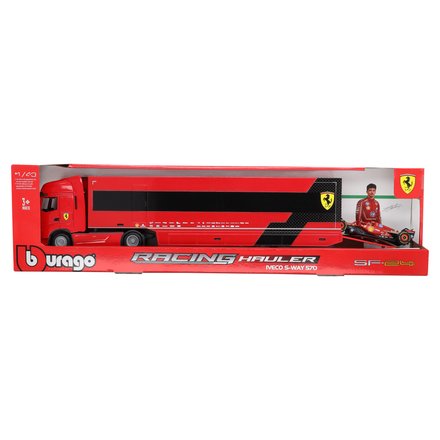 Save 30%
Scuderia Ferrari Iveco S-Way 570 Racing Transporter With One Car 1:43 Model
Scuderia Ferrari HP F1 Charles Leclerc Lego Helmet
Ferrari SF-24 F1® LEGO® Race Car
Scuderia Ferrari HP F1 Lewis Hamilton Lego Helmet
Ferrari's F1 car for 2020
The Ferrari SF1000 carries a name that is as much a tribute to history as it is a declaration of ambition. The designation commemorates Ferrari's entry into their 1000th Formula 1 World Championship race, a milestone celebrated at the specially added Tuscan Grand Prix held at the legendary Mugello circuit in September 2020. For the Scuderia, this was not just a race but a moment of profound institutional pride, marking over seven decades of uninterrupted competition at the pinnacle of motorsport.
Driven by Sebastian Vettel and Charles Leclerc under the technical leadership of Team Principal Mattia Binotto, the SF1000 faced a challenging season from the outset. The combination of a global pandemic that reshuffled the entire racing calendar and the fallout from controversy surrounding Ferrari's 2019 power unit left the team in a difficult position. An FIA technical directive on fuel flow monitoring had curtailed the engine performance advantage Ferrari previously enjoyed, and the SF1000 entered 2020 carrying a significant power deficit relative to Mercedes and Red Bull.
Despite this, aerodynamic and chassis development on the SF1000 showed genuine commitment. Ferrari's engineers worked intensively over the shortened winter preparation period to refine the car's front suspension geometry and improve its mechanical balance, aiming to make the SF1000 more consistent across a wider range of circuit characteristics. The car's aerodynamic philosophy built on the SF90, with revised sidepod geometry and updated front wing designs intended to improve airflow management and overall downforce efficiency.
Charles Leclerc demonstrated the car's remaining strengths by claiming pole position at the Austrian grand prix season opener and again at the Bahrain grand prix, a reminder that when conditions aligned with the SF1000's aerodynamic characteristics, Ferrari remained capable of extraordinary single-lap pace. Leclerc's driving talent was instrumental in extracting the maximum from the package throughout the year, with the young Monégasque driver consistently outperforming the car's theoretical potential.
The Ferrari 065 power unit at the heart of the SF1000 represented years of development within the constraints of the hybrid formula framework. The unit demonstrated improved reliability across the season, and Ferrari's energy recovery systems, the MGU-K and MGU-H, continued to play a central role in overall performance, with sophisticated deployment strategies developed in close collaboration between the drivers and their trackside engineers.
The SF1000 ultimately finished the 2020 season sixth in the Constructors' Championship with 131 points, Ferrari's most difficult result in many years. Yet the lessons absorbed during this challenging campaign directly informed the subsequent resurgence that would see Ferrari return to title contention. The SF1000 stands as the car that bore the weight of a thousand races, and the foundation from which a new era of Ferrari ambition was built.
SF1000 Technical Specifications
- Chassis made from carbon fibre composite monocoque with halo protection for the cockpit.
- Ferrari 8-speed quick-shift sequential carbon-cased gearbox, hydraulically activated, longitudinally mounted
- Servo controlled hydraulic limited-slip differential
- Brembo ventilated carbon discs (front and rear) with electronically controlled rear brakes
- Push-rod front suspension, pull-rod rear suspension
- Weight including coolant, oil and driver: 746 kg
- 13" front and rear wheels
- Bodywork and seat in carbon fibre
Power unit
Name: Ferrari 065
Cubic capacity: 1600 cc
Maximum rpm: 15,000
Supercharging: single turbocharger
Maximum fuel flow rate: 100 kg/hr
Configuration: 90° V6
Bore: 80 mm
Stroke: 53 mm
4 valves per cylinder
Direct injection, max 500 bar
ERS System
Configuration: hybrid energy recovery system with electric motor generators
Battery pack: Lithium-ion batteries with a minimum weight of 20 kg
Maximum battery pack capacity: 4 MJ
MGU-K maximum power: 120 kW (163cv)
MGU-K maximum rpm: 50,000
MGU-H maximum rpm: 125,000
✅ Check the Ferrari SF1000 launch photos
Latest News about the Ferrari SF1000 F1 car

Binotto admits car 'concept' may be flawed
2
Ferrari admits 'B' Ferrari car in the works

Ferrari plays down '30hp' Austria car upgrade
1
Glock: Vettel can beat Leclerc in 2020 car

Consumer group wants 2020 Ferrari car 'seized'
7
Ferrari says 2020 car 'extreme'

Ferrari unveiled their 66th F1 single-seater
1
2020 Ferrari SF1000 F1 car launch pictures

2020 Ferrari SF1000 F1 Car Launch video
1
Last updated:
Ferrari SF-1000: Frequently Asked Questions
Which team raced the Ferrari SF-1000?
Ferrari raced the Ferrari SF-1000 in the 2020 Formula 1 season, finishing 6th in the constructors' championship with 131 points.
Who drove the Ferrari SF-1000?
Charles Leclerc and Sebastian Vettel drove the Ferrari SF-1000 in 2020.
How many races did the Ferrari SF-1000 win?
The Ferrari SF-1000 did not win a Grand Prix; it took 3 podium finishes in 2020, with a best result of 2nd.
Which engine powered the Ferrari SF-1000?
The Ferrari SF-1000 used the Ferrari 065, a 1.6 V6 turbo hybrid power unit.