





Ferrari SF-26 Specs & Facts


Car Profile
 Ferrari
Season
2026
Constructors'
P2 358 pts
Races
14 (28 starts)
Photos
Ferrari SF-26 wallpapers →
Ferrari
Season
2026
Constructors'
P2 358 pts
Races
14 (28 starts)
Photos
Ferrari SF-26 wallpapers →Power Unit & Tyres
Drivers of the Ferrari SF-26


2026 Finishing Positions
2026 Race by Race


1Podium 7Points 14Outside the points DNFNot classified
Ferrari's F1 car for 2026
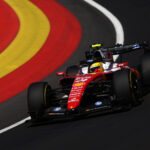
Ferrari SF-26 – medium-right-front viewThe Ferrari SF-26 marks the beginning of a new era in Formula 1 as the Scuderia embraces the most sweeping regulation changes the sport has seen in decades. The 2026 technical regulations introduced an entirely new aerodynamic philosophy, replacing the ground effect-dominated cars of the 2022–2025 period with a narrower design concept featuring active aerodynamic surfaces. Ferrari's engineers spent several years preparing for this regulatory overhaul, determined to build a car capable of ending their long wait for a Constructors' Championship.
The SF-26 is the second Ferrari Formula 1 car driven by Lewis Hamilton, who completed a headline-grabbing move from Mercedes ahead of the 2025 season. Paired alongside Charles Leclerc, Hamilton enters the 2026 campaign with even greater ambition. The new regulations presented a golden opportunity for Ferrari to reset the competitive order, much as 2022 had done, and with a full year of collaboration behind them, the Hamilton–Leclerc partnership is widely seen as one of the most formidable driver pairings on the 2026 grid.
Aerodynamically, the SF-26 features Ferrari's interpretation of the 2026 active aerodynamic regulations, which replaced the drag reduction system (DRS) with fully motorised front and rear wings. Drivers can switch between high-downforce and low-drag configurations depending on the track section, with the FIA specifying the permitted operating modes. The new rules also reduced the overall width of the car compared to 2022-era machinery, placing an even greater premium on aerodynamic efficiency and mechanical grip.
The SF-26 is powered by Ferrari's new 2026 power unit, built to the revised Formula 1 hybrid regulations. The biggest change is the elimination of the Motor Generator Unit – Heat (MGU-H) and a dramatic increase in output from the Motor Generator Unit – Kinetic (MGU-K), which now contributes roughly 50% of the car's total power. This makes energy deployment and battery management central to Ferrari's race strategy. The combustion engine retains the 1.6-litre turbocharged V6 layout with a 90-degree bank angle, now operating alongside a more powerful and efficient electrical architecture.
Ferrari enters the 2026 season knowing that the new regulations offer a genuine chance to challenge Red Bull, Mercedes, and McLaren for supremacy. With both Hamilton and Leclerc among the fastest drivers on the grid, a competitive SF-26 could make the Scuderia genuine championship contenders for the first time in years. Much of the season's narrative will centre on how quickly Ferrari can unlock the full potential of the new technical package and whether Maranello can turn their promising winter form into consistent results across the 24-race calendar.
Ferrari SF-26 – Technical Specifications
| Chassis | Ferrari SF-26 |
|---|---|
| Suspension (front) | Pull-rod |
| Suspension (rear) | Pull-rod |
| Aerodynamics | Active front and rear aerodynamic wings |
| Weight | 800 kg (including driver) |
| Tyres | Pirelli 18-inch |
Ferrari SF-26 – Power Unit
| Supplier | Ferrari |
|---|---|
| Configuration | 1600cc / 90° V6 turbocharged |
| Maximum RPM | 15,000 rpm |
Ferrari SF-26 – ERS System
| MGU-K output | ~350 kW |
|---|---|
| MGU-H | Eliminated (2026 regulations) |
| Energy store | 8.5 MJ |




Recent F1 Comments

Shroppyfly on 2026 Spanish Formula 1 Grand Prix Report & Results2 hours ago 
An Sionnach on 2026 Spanish Formula 1 Grand Prix Report & Results3 hours ago 
Nobodysperfect on 2026 Spanish Formula 1 Grand Prix Report & Results3 hours ago
All F1 Fan Comments